Monday, 26 July 2010

Reconstitution

I arrived in Nairobi at an interesting time for Kenyan politics. On August 4th, the Kenyan people will vote in a national referendum to decide whether to adopt a new draft Constitution.

Nairobi is buzzing with talk abour the vote: billboards (mostly pro-Yes) are everywhere, senior government officials have left to lead rallies in the countryside, radio shows talk about it constantly, and people debate the pros and cons of the new document. I talk with Kenyans about the Constitution many times each day. Most have strong reasons for or against it, but very few are willing to predict the sort of civil unrest that the vote with cause.

You might remember the ugly post-election violence in Kenya in 2007. Following the official declaration that Mwai Kibaki had won the Presidential election, ethnic groups allied with the insurgent (current Prime Minister) Raila Odinga staged a large number of non-violent and violent protests. They complained that the other side has rigged the election, a charge echoed by most international observers. The violence took different shapes in different parts of the country, with ethnic minorities from one party's camp being harrassed and attacked in areas dominated by ethnic groups aligned with the other candidate. The violence finally abated when Kibaki's and Odinga's factions agreed to an extra-Constitutional power sharing agreement with Kibaki as President and Odinga as Prime Minister. This arrangement was novel, but it was accepted by the courts primarily as a means to end the violence. As the conflict settled down, hundreds had been killed, thousands injured and tens of thousands displaced from their homes, particularly in slum areas of Nairboi such as Kibera.
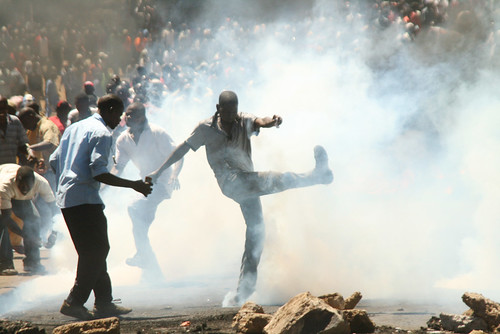


Before even talking about the current Constitutional battles, it's important to put the 2007 violence in context.

Kenyan politics are different from those in many countries. As one of my Kenyan colleagues pointed out, it's impossible to peg political leaders as left-wing or right-wing, progressive or conservative, traditional or modern. Although national politicians have views on particular issues -- education, trade, healthcare, housing, crime -- their positions don't really affect their voter base. Rather, political affiliations in Kenya are almost exclusively tribal. Kenyan politicians have an infamous and unfortunate track record of diverting public resources to their own -- or affiliated -- ethnic groups. Analysts have noted, for instance, that when control of the Presidency shifts from one group to another, funding to schools and hospitals in geographic areas populated by opponent ethnic groups tended to drop significantly. In light of such practices, it's easy to see how Kenyans could be very skeptical about politics and about the validity of their leaders' intentions. As a result of the patronage politics, elections (especially Presidential elections) are extremely high stakes. If your candidate wins, educated partisan cronies can expect plum jobs and the common follower can look forward to increased funding for public services. If he loses, however, they can predict that resources will be diverted to ethnic groups that backed the winner. A lot of this is described in Michaela Wrong's bestseller "It's Our Turn to Eat" -- http://www.amazon.co.uk/Its-Our-Turn-Michela-Wrong/dp/0007241968.

Combine high-stakes, patronage politics with endemic campaign corruption* and voter fraud and you can a lot of angry people at the polls.

It's an easy contrast with Tanzania, which has a drastically different political environment. Tanzania's post-independence leader, Julius Nyerere, had a very different vision for his country that his Kenyan contemporary Jomo Kenyatta. Nyerere had communistic ideals and believed that the natural mode of living for sub-Saharan Africans was a traditional, communal, family-centered village. He believed that the ideal economic mode of production was also the commune, a strategy which was not particularly effective for increasing agricultural output. Nyerere also stressed national unity - he oversaw the unification of Tanganyika and Zanzibar into modern-day Tanzania, promoted the use of Kiswahili as the official national language, and encouraged national Tanzanian identity over ethnic-tribal identities such as the Sukuma, Yao or Suba**.

If it's hard to say which approach is better, it seems obvious that the differences in vision between Jomo and Julius produced a real divergence between their countries. In Kenya, politics is contentious, tribal and high-stakes; in Tanzania, a single party - C.C.M. - has ruled the country since independence and political battles take place (when at all) around local parliamentary elections. In Kenya, people feel strong tribal identities and prefer to speak their native tongue or English (which they can do well); Tanzanians have embraced Swahili as a lingua franca but generally can't speak English well. Kenyans are (as a rule) entrepreneurial, competitive and trade-oriented; Tanzanians are more relaxed, more trapped by red tape and high tariffs, and less competitive within the region. Kenya performs significantly worse than Tanzania in terms of wealth and income inequality. (On land inequality: three families in Kenya each own 1 million acres of land. On income inequality: as measured by the UN's Gini coefficient index, a widely accepted indicator of income inequality, Tanzania has a 34.6 - in between France and Australia - while Kenya gets a 47.7, meaning that income distribution is more unequal than in the United States, and almost as unequal as Brazil).

Thanks to its more commercial orientation, Kenya seems to have come out ahead of Tanzania economically. In terms of politics, though, Kenya seems to have it bad: ethnic tension, tribal identities which override national unity and debate of issues, endemic corruption and substantial inequality in both land holding and income. As a function of these structural problems, political decisions (such as elections) can lead to violent results, often along ethnic lines.

Now that Kenya is moving full swing into the national referendum to approve the new Constitution, who knows how things will shake out? The Constitution contains the usual sorts of provisions found in constitutions drafted since World War II. There are the usual things related to the branches of government, stronger separation powers, the right to vote, to free speech, etc. These aren't controversial. Like many African constitutions, this one protects so-called "second generation" or "affirmative" rights: healthcare, education, housing, fair wages, culture, and family life, among others. Although it's unlikely that the Government of Kenya could actually provide all those rights, no one is going to object to that sort of language.

Three parts of the Constitution have been the source of debate:
- Abortion. Abortion is currently illegal in Kenya and you can go to jail to performing one or undertaking one. The Constitution officially outlaws abortion but provides for a number of open-ended exceptions that many conservatives (primarily Catholics) think will increase access to abortions in Kenya.
- Kadhi (Islamic) courts. The Constitution provides for the official establishment of Kadhi, or Islamic courts in Muslim areas. It also provides for exceptions to certain provisions of the Bill of Rights for professed Muslims. Although Kadhi courts currently exist (with statutory, rather than Constitutional backing), you can imagine that this has pissed off the Christian set.


- Land. It's a little unclear what Chapter Five actually means for land reform, but the section is widely understood to mean that the Constitution empowers government to ensure equitable distribution of land, including reversing some illegitimate purchases (land grabbing) that go back to the post-independence period. Because Kenya has such uneven land distribution, this is of major concern to landholders in the Rift Valley who stand to lose a lot if their sketchy land deals get investigated and possibly invalidated. As a result, Daniel arap Moi and his cronies have been telling Nairobians that if the Constitution passes, Maasai herders will come and seize all their land. Some people actually believe this.

But it's not just the major points of debate that pose problems. Getting a country of almost 40 million people, many of whom don't speak English and have limited schooling (let alone legal education), to understand a massive documents with hundreds of parts is an insurmountable task. As my driver yesterday, Peter, pointed out, he speaks English fluently but doesn't have the legal education to understand what the provisions really mean. ("If you have not been trained in the law, how can you know what this really means?"; "What does it mean if [the Constitution] says 'the government shall do something'? That's in the future."). Of course, there are people on both sides of the debate constantly telling him what it means, but he doesn't trust what they say. So even though he has read parts of the Constitution, he's not even sure he will vote in the end. Peter was most worried about his old grandmother in the village, who doesn't see well and can't speak English; he's concerned that if she tries to vote, the people at the polling station might trick her into picking something she doesn't want. Getting to the polling station is only half the battle.

All the issues inherent in the Constitutional referendum - the high-stakes outcomes, the propaganda, the lack of understanding of its contents, the underlying ethnic tensions - are going to make for an interesting vote next Wednesday. I just hope that no one gets hurt.

* Corruption is generally bad. Transparency International gave Kenya a corruption ranking of 146 out of 180 in 2009. This put it on par with Russia, Zimbabwe and Ecuador.

** There is one notable exception to the unity and uniformity of Tanzania - Zanzibar, which has courts with the jurisdiction to hear Islamic law claims and whose residents tend to vote for minority political parties such as the C.U.F. The Zanzibari exceptionalism enshrined in Tanzania's legal structure stems from the negotiations that took place at the time of union between Zanzibar and Tanganyika, theoretically a merger of two equal sovereign states. It's similar to special legal treatment for Texas or Quebec.

*** For a copy of the draft Constitution, click here: http://muigwithania.com/2010/05/05/kenyan-constitution-pdf/. Warning: it's long.

Sunday, 25 July 2010

Kiberans

My roommate and I went to Kibera yesterday. I wanted to see the slum; she wanted to take pictures. As I mentioned last post, Kibera is a famous and massive slum settlement within the jurisdiction of Nairobi Area. Kibera was originally a well-to-do settlement occupied by Nubian soldiers who had been granted land by the colonial government in gratitude of their service of Great Britain in the First World War. Over time, more and more people from outside Nairobi moved in to Kibera and rented out simple rooms or built makeshift homes out of simple materials. Today, it's gigantic, with a hard-to-gauge population estimated between 600,000 and 1.5 million residents. (As I stated last post, it's widely considered Africa's largest slum. This is probably accurate, although it depends on the estimate you use for Kibera's size). It's very poor, with dangerous health conditions, lack of good drinking water and a constant risk of crime, especially after dark. In addition to the usual, everyday struggles of Kiberan life, the residents have to cope with frequent flooding, police violence (http://updatesonkenya.blogspot.com/2008/01/massacre-in-kibera-msf-doctors-without.html) and occasional slum clearing efforts that force the residents out of their homes (for a positive spin, see http://news.bbc.co.uk/2/hi/africa/8258417.stm). In a nutshell, life is tough. Another fact: a number of movies (including The Constant Gardner) have featured scenes shot in Kibera... so you may have seen it before.

Instead of trekking around the settlement, we spent part of the afternoon at a community center in the "upper class" part of the slums. The idea of an upper-class slum sounds like an oxymoron, but poverty and poor living conditions are relative in Kibera. The area where the community center was located was pretty decent -- vehicle-accessible, equipped with running water, and dotted with little businesses that seemed relatively prosperous (my favorite was a women's clothing store: "Ghetto Fabrics. Respect Tha Motherhood").

The fact that we ended up at the community center shows just how tightly-knit the expat scene is in Nairobi. On Thursday, I went to the birthday party of a guy I just met, where I met a French guy who has recently taken over sponsorship of a women's group in Kibera from another girl. Since the original sponsor left, the French guy had taken it upon himself to go every Saturday and play with the children who come when their mothers are at the women's group. He invited me to go. Bizarrely enough, when we got there, I ran into Josh, a fellow development person that I have run into all over the place: Kampala, Boston, and now Kibera. It turns out that he's working on a project in Kibera for an extended period. The chance of running into someone you know inside the slum seems slim indeed.

Playing with the kids was great. We did some dancing to Nigeria, East African and American hits, kicked around a soccer ball and did airplane rides (an exhausting activity which consists of me throwing the kids up into the air and catching them). I particularly loved that the kids - unlike older Kenyans - were more than happy to speak to me in Swahili. When I speak to an adult Kenyan in Swahili, he or she will almost always switch to English immediately. Maybe because they haven't spent much time in school yet, the kids were immediately comfortable with Swahili and played right along. I guess those with younger siblings were probably used to speaking with someone who talks like a 3-year old.

Here are some snaps. The first picture is mine:


The second picture comes courtesy of my roommate, a professional photographer with some great African work -- http://jeancurran.com. In this photo, we are dancing to one of Nigerian favorites. In case you were wondering:


I was feeling pretty sick on Saturday so we didn't end up staying very long. Playing with the kids was a blast, though - I'll be back there on other weekends.

Before I go, a quick note about Map Kibera, Josh's project. As you might guess about a giant, unplanned settlement like Kibera, there isn't much in the way of official maps. For proof, look at Google Maps, which does a great job of Nairobi if you're looking a nice restaurant in Westlands - Kibera is essentially a grey area (http://maps.google.co.ke/maps?q=map+of+kibera&oe=utf-8&rls=org.mozilla:en-US:official&client=firefox-a&um=1&ie=UTF-8&hq=&hnear=Kibera&gl=ke&ei=0eVLTMaSHIWv4QbBxYyaDA&sa=X&oi=geocode_result&ct=image&resnum=1&ved=0CBoQ8gEwAA). The lack of maps isn't a major problem for residents, who know their communities very well. It is a problem, however, for development practitioners and government planners looking to provide much-needed basic services to Kibera. Without an accurate mapping of residential areas, businesses, religious centers, schools, hospitals, pharmacies and places to get water, it's very difficult to ensure that interventions best serve the needs of the million-ish residents of Kibera. Enter Map Kibera (http://mapkibera.org), an interesting collaboration project that's working to map the key resources within Kibera. The project is substantially underway and has mapped a huge part of the settlement with the help of tech-savvy resident trainees. It's worth taking a look at his interesting example of information technology being harnessed for development (this type of thing is known in the biz as ICT4D).

Saturday, 24 July 2010

Settling

I like to make a blog post right when I arrive in a new country. It helps me capture my first impressions about a place more accurately. That hasn't happened this time - I got in Sunday night and waited until today (Saturday) to write this. So please join me for some week-old first impressions.

For having been here a week, I feel like I haven't seen much of Nairobi so far. The other places I've gone to are Kileleshwa (a decent neighborhood where I live), Westlands (a swanky zone where every other expat lives), Upper Hill (where I work - on a hill) and Statehouse (where I spend 30+ minutes every day mired in traffic). I have only a vague sense of where things are - it's just like traveling through random points in space. Nairobi isn't thought of as a nice place to live (e.g., - one of worst 50 places to do business as an expat: http://www.nation.co.ke/News/-/1056/592780/-/u65oaa/-/index.html), so I was suprised to find that the parts I've seen are nicer than expected: hilly, tree-lined streets, nice houses and apartments, great views (esp. from Upper Hill). The only real bummer is the lack of accessible green space, but it's not really a problem with the serengeti and ranges of hills just outside the city.

There are less nice parts of the city (whose nickname is Nairobbery). One of the most famous areas, though not necessarily the most dangerous, is Kibera, the world's largest slum. Kibera Slum is a giant area with a (human) population the size of Manhattan and quantities of small livestock to match. Like the infamous favelas of Brazil, Kibera has attracted plenty of attention from development types (who are involved in improving conditions there) and tourists (who pay locals to take them on protected slum tours). Although I find the idea of ogling at urban poverty on a tour distasteful, I'm toying with the idea of going there this weekend to check it out.

Currently topping my least favorite things about Nairobi is the traffic. I have been here for less than a week days and have already spent (easily) six hours on the road getting between home, work and dinner. My taxi drivers have repeatedly suggested that I try not to travel during rush hour, which apparently extends from 7:30 am-8 pm with occasional lulls in mid-afternoon. I'm sorry, but traffic or no traffic, I am not getting out of bed at 6:30 in order to beat rush hour. But it's not all bad; the silver lining to the dark cloud of long taxi rides is listening to hilarious morning talk radio, which divides airtime between discussing marital infidelity and government corruption. But that's a whole separate post.

My living situation is great. One of my friends hooked me up with a place that I share with two Irish expats. One's a journalist for the Irish Times and the other is a freelance photographer-slash-photojournalist. They're both laid back and fun, and it's refreshing to live with people who aren't in my line of work. It seems that the vast majority of expats my age also work in development, so I'll get enough of that socially. I see living with a professional photographer as a chance to finally learn how to improve my technical skills beyond using the Sepia and Color Swap settings on a my Canon PowerShot. For the price, the apartment is pretty good. On one hand, I sleep in a single bed, my room is a little bit cold, and the shower is lukewarm. On the other hand, the common area is nice: clean, parquet floors and semi-cheesy safari-theme furniture that I really like. Here's home:


Socially, Nairobi seems more surreal than anything. I went out a few nights this week for dinner with other expats. The places we ate could easily have been in New York or Washington (although here, prices are substantially cheaper). Over three nights, I ate at a sushi restaurant, an Italian place with brick-oven pizza, and a swank fusion brewpub. I wasn't trying to go to fancy places, but it's just where many people - Kenyans and foreigners - seem to go out around here. The area where most of the expat action takes place (Westlands) is a really high-end stretch of the city with nice cars, gleaming shopping malls, international cuisine and trendy bars. I guess the fact that there are so many creature comforts explains so many business, NGOs and international institutions have major regional offices in Nairobi. I'm happy to have access to nice things, but I'd love to spend more time at basic local places... I miss last summer's daily regime of Swahili coconut rice, brown beans, collard greens and mishikaki (grilled beef skewers).

That's all for now. Will write more soon.

Thursday, 22 July 2010

Rebirth

Hey everybody. After a long wait, Tanzlines is back!

For those of you with whom I haven't been in touch recently, life has been busy since I last blogged. I've wrapped up my second year at Harvard Law, worked on some land-reform projects with the Millennium Challenge Corporation, taken a few personal vacations and spent two months as a deal-lawyer-in-training in Skadden Arps' Washington office.

As usual, though, I've found my way back to Africa. This time around, I'll be based in Nairobi until early September. I landed an exciting opportunity to work with the International Finance Corporation, a branch of the World Bank Group that helps countries grow through investment (rather than just aid). My project involves helping the governments of the Great Lakes countries (collectively known as the East African Community) reform their business laws in order to grow. But more on that later.

This season, you can expect the usual mix of Tanzlines posts: part travel tales; part thoughts on development, social enterprise and law reform; part musings on life in Africa.

Please follow me, share posts and write comments. More to come soon!

Friday, 29 January 2010

Parting Words

My last afternoon in Ghana -- January has really flown by!

I thought I would write a final post to reflect on my trip this past week -- a little bit of Ghana, some Togo and a bit of Benin.

As my project was wrapping up in January a couple of weeks back, I was thinking ahead to the week of solo travel I was about to undertake. I had been gradually coming to the realization that I might be evolving out of the budget-backpacker phase of my life.

This transformation first struck me last December, when I started thinking about taking a week off HLS to squeeze in a trip to Togo and Benin. Although I ended up skipping school and traveling anyways, I found myself somewhat less enthuasiastic about the trip than I would have, say, a year or more ago. There was a long period of my life where I craved what backpacking had to offer: finding new adventures, crossing crazy borders, overcoming language barriers, walking far off the beaten path, making new friends and partying in strange places. And, to be honest, I actually liked certain parts of budget/backpacker culture (although I have *always* despised the pot-smoking/traveling kid/quasi-Rasta/hippie types that you meet at most hostels).

It's not like I hate traveling all of a sudden. I am still excited at the prospect of working in interesting locations abroad, but the excitment of traveling crazy places just to be there has worn off. Maybe it's growing up, or maybe it's having done so much independent traveling already. On the bus this morning, I figured out the number of countries that I've visited: it's 70+. The number is amazing or disgusting depending on how you look at it, but either way, it's a lot of ground covered.

For these reasons, I have treated the past week in some ways like my 'last' true backpacking trip. There is a certain symmetry in this formulation; in January of 2003 I came to Senegal, also in West Africa, which kickstarted my life as an independent traveler. Although I've covered fairly little ground in the past week, it feels as if I've done a sort of one-week West African redux.

There have been good things, bad things, and (as usual) funny things.

This trip has reminded me of the many pluses of traveling in West Africa:
- genuine hospitality (cliched but true; I have met many people in the past week alone who invited me to dine with them, stay at their place, meet their families, etc.)
- excellent dairy products (FanYogo in Ghana, lait caille in Benin)
- the music (acclaimed as the best in Africa. If you haven't checked out the following, you should: Senegal (Youssou Ndour, MC Solaar, even Akon); Mali (Salif Keita, Amadou et Mariam); Burkina (Ismael Lo); Benin (Angelique Kidjo); Ghana (Tinny and other hip-life artists).
- nice border crossings (in general)
- awesome and accessible sights: the stilt village, the vodou market, the crocodile pond, crumbling colonial towns, bustling cities, beachfront hotels, just to name a few options
- reasonable prices

The bad things about traveling (in this region especially) are also there. There are things you never really like, or get used to, no matter how many times you face them:
- the same relentless and irritating quasi-Rasta street hustler/drum instructor/souvenir salesman in every town
- the bizarre charges that people try to apply to the foreigner (e.g., a surprise "electricity surcharge" at my hotel in Lome where I had to pay $3 for use of the fan overnight; the 1,000 CFA pilfered by the Togolese border guard)
- cramped, shared long-distance transport (always inevitably with large individuals seated next to you)
- a very real chance of destruction at the hands of a zem driver, taxi driver, bus driver, tro driver, or any operator of motor vehicles
- starch overload; if I was carb-loading, I would have enough to run an Iron Man right now
- astonishing lack of respect for women (sadly, not limited to here)

Despite these irritations and drawbacks, traveling in West Africa never fails to make me laugh at least once a day. When I crossed into Benin five days ago, I lost track of my shared taxi and its driver (since they had no paperwork to complete). I looked and looked but couldn't find them anywhere on either side of the border. I felt sure that the driver had left without me and taken my pack with him. I wandered back to the Beninese side to find onward transport on my own and ran into the taxi driver. He said that he had been looking everywhere and that he whole carload was worried and waiting. I felt really bad at this point, and I suggested that we run back to the car (about a quarter-mile away) so as not to hold up the others any longer. When we were jogging, we passed two policemen who started blowing their whistlesand motioning us to pull over as if we were two speeding cars. Everyone around (including us) burst out laughing at the absurdity of a running white guy being pulled over by the cops.

My experience in Weta two days ago (see post immediately prior) was another reminder of the hilarity that happens when two cultures clash (in that case, those of American gangsters and Ewe villagers).

Even the shop names in West Africa have a sense of humor. Stores and vehicles have amusingly-worded religious titles: a taxi named "Junior Jesus," the "Let Them Say" canteen, "Havard Kiddie's University" [sic] (a primary school), and the profusion of "God's Time Is The Best" boutiques and restaurants. The small stand pictured below (in Weta) is typical of what you see around the region:


All in all, my past week was more interesting, more fun and less stressful than I thought it was going to be. Ending on a high note is a good thing.

It's probably premature to say that I've hung out my trusty backpack entirely, and I'm sure that I'll find myself in a budget hostel again before too long. It probably is fair to say, though, that I'm going to be looking for different types of travel from here on out.

Thursday, 28 January 2010

Weta 4 Life!

Two days ago, I crossed back into Ghana from Togo. I faced a minor incident at the border. The half-mile stretch of road at the Togo-Ghana border has a number of vaguely official looking checkpoints, manned by officials in blue or green camo gear or police uniforms. I never really understand where I'm supposed to stop or what I have to do... I usually just walk straight past everyone unless a guard calls me to come over.

This time, a guard summoned me over right after I got my Togo exit stamp.

"What are you bringing back with you from Togo?" he asked.

I felt like answering "probably hookworm and malaria" but I decided that he probably wouldn't get the joke. I told him: a small fetish, some Ashanti masks, Togolese clothing. The guard said that he would have to check and see if any of the items were cultural relics being taken away in contravention of an international agreement called "CITIS" (at least, I think that's how it's written). I told him that unless priceless Togolese relics were available at the tourist market for less than $5, I was probably ok. The guard started to get mad and insisted that I take everything out and dump it on the ground. A sketchy-looking guy with bad teeth whispered that I should just give him 5,000 CFA (~$11) to shut him up, but I was having none of it. The guard was yelling at me and threatened to take away all my souvenirs but then saw a 1,000 CFA bill among my things and pocketed it. I looked at him, incredulous, but he said that I could leave and that I passed the inspection.

As I was stuffy my sandy clothes back into my bag, the guard shook his finger at the bedraggled man with bad teeth who was still lurking nearby. "Watch out for him. That man is a thief," he said, shooing the guy away. I think the irony was probably lost on him.

Before I went away, I decided to mess with Captain Corruption a little bit. I gave him a friendly, I'm-not-mad-about-the-1,000-CFA smile and got him to tell me his name. "David Esegma? I'll remember that. My uncle advises your President on matters of corruption. I'll make sure to pass along your name to him." This was perhaps a dumb thing to do, but it sure was fun. I haven't seen an African official look so unhappy in my life.

Facing petty graft by military officials is never fun, but I put the experience in perspective. This is the only time I've ever faced bribe-taking like that crossing a border -- not just on this trip, but across all trips to West Africa. It says a lot about the quality of ECOWAS' success at regional integration, in my opinion.

Once in Ghana, I decided to visit Wisdom, an Ewe guy my age that I met on the tro-tro to Togo a week earlier. Before we parted ways the first time, he made me promise that I would visit his village before I left.

Wisdom (his Evangelical Presbyterian baptismal name) lives in a small village called Weta deep inside Volta Region, a rich and fertile farming area bordering large stretches of Togo. I enjoyed relaxing and hanging out in the village. It was completely relaxing, since there was absolutely nothing to do except visit people in the village, eat dry Ewe biscuits, and drink Malta Guinness (a non-alchoholic malt beverage, made by the Irish beer company, that tastes like milk at the bottom of your cereal). Wisdom made me Jollof rice for dinner, and it was very good, but way too filling -- I was still full by the next morning.

There were some humorous highlights to the visit as well. Wisdom and his buddies (Debaris and Thomas) were very nice village kids. Wisdom described himself as a family guy and very obedient to elders, as well as a hard worker (which I observed to be true). He helps his relatives run the Weta town general store most days. But Wisdom also likes American hip-hop and gangsta' rap (his words, not mine).

I didn't pick up on the rapper-obsession at first, but it crept into the conversation when I dropped my stuff off at his house in the afternoon. We had been talking about Wisdom's involvement in the church on the way there.

"Nice house. Very big," I said.

"Yeah," he said. "This my muthaf*cking residence, niggah!"

You know those times when you really want to laugh, but know you shouldn't? This was one of those times. Wisdom, whose English was the best of his friends, wanted me to teach him the right way to speak "Negrin," as he called it -- basically, the way American rappers talk. I tried to do that with a straight face for about fifteen minutes, and they couldn't get enough of it. My main teaching contribution, I think, was to explain the meaning of "cap yo' *ss" and suitable places to use it, as well as describing the importance of "rolling deep," and how many people were required to constitute acceptable deepness. Of course, the fact that I was teaching young African guys how to speak in African-American slang has got to be pretty high on the irony-meter.

Here are Wisdom and I, somewhat at a loss for the right hand signals to make. (Where's my brother Calum when I need him?)


Before I left, the guys took me to see the massive rice fields growing outside of town. While we were touring the paddies, we met Richard (the "biggest gangsta' in Weta" according to Wisdom). I guess he's the biggest gangsta' because he had dreads and because he does that Rasta thing where you touch your chest after you shake someone's hand. Maybe that wouldn't cut it in Compton, but it's all relative, right?

Richard the Gangsta' was working the rice fields when we came along. His English wasn't great, but he could understand if I spoke slowly. I asked if he was the owner of the field next to us. He made a sweeping gesture with his arm. "Yeah, all this is my shit! Rice, man!" When we left, he went down to the hut to help his mother with harvesting.

Before I left town, I stopped in at Wisdom's family's shop to say goodbye to people. Or, as my host put it: "let's give a big shout-out to all my niggahs!"

Check out this homeboy. He was briefly the eighth-biggest gangster in Volta Region:

Tuesday, 26 January 2010

I have this fetish

[People who don't like grisly or macabre things, this post is worth skipping.]

Back again, with reports from sunny Togo.

I went earlier today to the Fetish Market just outside Lome. To clear up any confusion: it is not a meeting place for Togolese sexual deviants. Rather, it's a place where people can meet with vodou practitioners, buy components for vodou magic, or just pick up bizarre animal-based souvenirs to horrify their families with.

The fetish market is genuinely fascinating; it's a courtyard filled with stalls piled high with all sorts of vodou components and bizarre curios. Most common are the dried animal parts. They stock an impressive selection of mammals: leopard skins, puppy pelts (a la Cruella), monkey heads and feet, even a whole dried bat! They have a large buffer stock of dried reptilian and amphibian life (ex-life?) -- dried frogs, lizards, snakes, baby snakes, baby lizards, etc. There are numerous bone-based carvings which offer protections against a number of maledictions. I should note that the range of skulls was very substantial, with everything from tiny rodent heads to a half-shattered elephant cranium (tusks gone, of course). Here are some medium-sized heads (mostly primate) for your grisly viewing:


Although it probably plies a good trade selling to tourists, the market has genuine links with vodou. Vodou (or vodun) is the name of a set of religious practices from coastal West African, but centered around Benin. New World interpretations of vodou have given birth to the popular understanding of voodoo, at least as portrayed in a number of Hollywood movies (aside: the worst of these is surely Skeleton Key, starring Kate Hudson). So, many of the items the vendors sell are indeed traditional healing items or components of various vodou spells.

Surrounding the animal-part heaps are a number of vodou shrines, which double as boutiques where various relics can be foisted on the eager tourist. The first shrine I went to was staffed by two very young kids (the eldest was probably 11) who were subbing in for their father, who was in Nigeria. They explained a number of different herbal remedies to me and asked if I would like to try a pungent-smelling stick that the kid claimed was "comme prendre le Viagra naturel" if boiled in water. How does an eleven-year old know about that stuff anyways? Kids these days!

The next shrine I went to was staffed by a priest and a translator who explained the properties of various charms: a traveler's talisman, a memory-enhancing device, a love amulet, a gri-gri to enhance luck, a little clay figurine to whom you feed a cigarette in exchange for protection. They were all arranged against a clay monster-looking thing that I later learned was the god of the shrine. When the priest said a blessing for me and rang a bell at the clay god, I knew I was in the middle of an elaborate sales pitch. When we finished the introduction, the priest asked me if I wanted to take any charms, and that if I did, the god could suggest a price for them. I agreed, because I had to see how this pitch was going to play out.

Here's how it went: I picked out a few charms that I said I wanted and the priest muttered things in Gbe and threw some cowrie shells on the ground. He talked to the god for a moment and then told me that the god (lucky me) was willing to reduce the normal price by 60% and offer me the talismans (talismen?) for a mere 9,000 CFA ($20). I asked the priest to tell the god that I was a student and could probably only pay 1,000 CFA for two items, so I couldn't pay the god his original price. (Although really, if the god was so great, wouldn't he have known how much money I had?) The translator explained this counter-offer to the priest who relayed it to the god, who replied that it was willing to lower its asking price but that I could only have one charm for 1,000. The god also said that if I was willing to throw in a little more, I could take a picture with him and get the phone number of the priest for a follow-up call. Would that I had the money!

In the end, the experience was highly amusing and quite informative. I am also the proud owner of some vodou items blessed by the small and tough-bargaining clay god of Lome.

If you are interested in finding out more about the Fetish Market, you can probably find stuff online, but you might want to make sure your Adult Content filter is switched on. Because of the name and all that. I'll also upload some videos of the market when I get back to the US. Until then, may the god(s) be with you.