Well, folks, my time in Nairobi has come to an end. I'm writing this one from Dulles Airport on my way back to Cambridge! (It seems a little anti-climactic, I know, to write a final blog post after leaving Kenya. But my power was out all day Friday, so I had no choice.)
The past eight weeks have flown by quickly. I think this is partly because of the excitement of being in a new place, and partly because I've been traveling so much within the region. The past four weeks have especially been a blur: a hike up Mount Kenya, trips to Burundi, Rwanda and Tanzania, and meetings all over the place.
In the end, living in Nairobi has come as a pleasant surprise: I like it there now. Initially, I didn't. The traffic, pollution, fear of crime, and utter lack of charm all added up to a crappy first impression. But since then, the city grew on me. The food has been a major plus (Japanese! Ethiopian! French!), as have the benefits of Swahili-only-when-you-feel-like-it. Meeting other people has probably been the best part, though. This city is full of great, warm people doing fascinating and important work in areas I find interesting - politics, international development, reporting, impact investing and social enterprise. The people I spend time with outside of work are uniformly passionate about what they do, which I find refreshing and inspiring at the same time. And I've made some good friends.
My work has also been pretty positive overall. My team at the IFC gave me a lot of responsibility and some very interesting projects to work on. I'm glad to have played an early role in shaping the East African Community's common market strategy, a political and economic goal that I really believe in. It's been especially interesting traveling to the EAC capitals to meet with officials there. The development challenges and preoccupations of the five member states couldn't be more different, from creepily efficient Rwanda to backwards-and-we-know-it Burundi. On top of the work itself, I've really had fun with my coworkers - they're smart, welcoming and talented people. They've taught me a lot about avoiding, flattering, convincing and otherwise dealing with difficult public officials and antagonistic clients - I hope I've picked up some of that from them. The team even threw me a very nice sendoff lunch at my favorite place on Thursday, which I thought was a nice gesture.
Although I'm sad to have left, I have two great things to look forward to right away. Tomorrow, I'm going to the wedding of two good friends in Cambridge, then I'm visiting the beautiful Stephanie in San Francisco. The expectation of things to come was almost enough to dull the pain of tonight's 30-something hour journey back to Massachusetts (although it does not remedy the sad fact that I watched Prince of Persia to stave off in-flight boredom.)
So this will be the last Tanzlines post for a while. In terms of exciting African adventures ahead, the next one will probably be next January in southern Africa. Hang tight until then!
Showing posts with label Nairobi. Show all posts
Showing posts with label Nairobi. Show all posts
Saturday, 11 September 2010

Friday, 6 August 2010
The Infidelity Hour
You probably know that I hate Nairobi traffic. There is, however, a silver lining to the dark thundercloud of Kenyan gridlock: morning talk radio.
The taxi company that I take to work caters mostly to international community workers, and the drivers are required to pick the same English-heavy channel every morning. The DJ and callers speak mostly in English with a sprinkling of Swahili, so it’s easy to understand.
Between 8:00 and 9:30 am, the discussion is devoted to two topics: public corruption and infidelity. Corruption discussion = boring. But discussions on cheating = hilarious, depressing and revealing, all at the same time.
The show uses the same format every time: the discussion typically kicks off around 8:15 with a story about a man or a woman who was caught cheating, who cheated without getting caught, who caught his or her partner cheating, who knows someone who is a mistress, who suspects they are being cheated on, or who has an interesting anecdote about cheating. After the DJ has explained the story, he asks listeners what they would do if they found themselves in that person’s shoes.
(Actual) examples have included:
1) Story: a married Kenyan woman gave birth to her third child. The child was visibly half Caucasian. Her husband was very upset and at a loss of what to do. Question: what would you do as a man in this situation? Do you leave your wife?
2) Story: a recently married man finds that his girlfriend spends a lot of time out with her girlfriends and doesn’t get home until quite late one or two nights a week. She doesn’t tend to call or text while she’s out. Question to men: do you think it is important to tame your wife once you get married? To women: do you think you need to be tamed?
3) Today’s story: the king of Swaziland (honest!) had his police raid a hotel and found that one of his ministers was sleeping with one of his wives. (Aside: who is dumb enough to sleep with the wife of an absolute monarch?) Question to men: have you ever caught your partner in bed with a close friend? And what did you do? To women: have you ever been caught red-handed?
4) Story: a man tells his mistress that his wife suspects he is being unfaithful. The mistress is worried about her identity being discovered and facing the wrath of the wronged wife. Question to mistresses: have you ever faced the wrath of his wife? To wives: have you ever had to deal with a mistress? Do you do it directly or indirectly through the husband?
The stories are rarely as interesting as the sound bites from the people that call in. There are angry callers and calm ones, mistresses and wives, men and women, people with firsthand accounts and people who answer in hypothetical. The callers are an interesting glimpse into how fidelity is seen in Kenya: publicly condemned, definitely widespread and even accepted as a fact of everyday life.
One of the most surprising things about listening to the Hour of Cheating is how reasonable and un-macho many of the male callers are. In response to today’s story, a number of Kenyan men called in to discuss how they would handle their wife giving birth to a child that was obviously not theirs. One pointed out that it was the husband’s responsibility to keep the family together, no matter what happened, and to be a good father to the child even if it wasn’t biologically his. Another explained that infidelity is painful, but it’s a wound that can be repaired if the woman is willing to amend her ways and not do it again. A third said (correctly, I’d say) that men become extremely angry when they first find out about infidelity but that they calm down in the end. Maybe the callers on this show aren’t representative of the general population, but their responses seemed more understanding and forgiving than I would have expected.
There are some less surprising aspects of unfaithfulness. Infidelity in Kenya, I have gathered, is often a partly financial relationship. Certainly engaging a prostitute is a very common pattern for some men – and is purely transactional. But a typical pattern of long-term infidelity involves a married man having an affair with a younger woman (who may or may not be married herself). We can call this type of relationship the “sugar daddy affair.” This arrangement should be familiar to most readers: the man generally provides the woman with money, entertainment and things; the mistress enters into a kind of medium-term goods-for-services exchange. In many cases, there is an emotional component, but the financial aspect is never too far below the surface. Last week, when a female caller (who claimed to be a mistress) explained that she never received any material things from her lover, the DJ and callers expressed shock at the situation.
According to many of the wives who call in, they often suspect that their husband is being unfaithful without any concrete evidence. But since extramarital affairs have a material component, the struggle between the wife and the mistress is not only a fight over dignity and love, but also over financial resources. As the DJ frequently points out: if you can’t tell exactly how much money your husband is bringing in, how can you be sure that he’s not buying his mistress a car or giving her money for school? For wives and mistresses, it’s a zero-sum game; what the mistress gets, the wife and kids don’t.
Although the discussion about infidelity on the radio is often gossipy and matter-of-fact, the issue of infidelity (especially sugar-daddy affairs) has two major implications from a development standpoint.
First, infidelity, and having multiple partners in general, is a major health risk. In Kenya, infrequent condom usage combined with high STD rates and widespread infidelity is (quite literally) a deadly combination. The problem is the same in other East African countries. Public health workers across East Africa see sexual transmission of major diseases such as HIV as one of their top priorities. Sugar daddy-type affairs often involve older men and younger women, which lead to the intergenerational spread of HIV. As my health-worker friends point out, the intergenerational transmission of HIV/AIDS is one of the main ways that HIV levels remain so high, since younger generations get infected earlier than they would if sexual activity was confined to peers.
Overcoming dangerous sexual practices is hard work. Last summer, Uganda and Rwanda launched “anti-sugar daddy” campaigns: one sign in Kampala showed a young girl in a college uniform making a ‘no’ sign with her hand to an older man in a luxury car. (Oddly enough, the government was gender neutral enough to print “anti-sugar momma” posters: a young man refusing a beer from an older woman in a suit – a somewhat less likely situation). On the shores of Lake Victoria in Tanzania, signs in Swahili said ‘If you truly love her, you’ll protect her,’ with regard to condom usage and affairs. In downtown Dar-es-Salaam, humorous murals reminded passerby that sleeping with teachers and government officials was a dangerous and unhealthy practice for young women.
The second problem relates to savings and investment. One of the phenomena familiar to African development workers is the so-called “girl effect” – the notion that females are much more likely to invest money they receive in health, education of children, basic needs and savings. Men, in general, spend a much larger share of funds on luxury and unnecessary items such as alcohol, women, imported goods and entertainment. This isn’t to say that men are always less wise with their cash, but there is considerable evidence that this tendency holds true overall. Many microfinance institutions and development organizations will only work with women for this reason. When there’s only so much money to go around, they reason, why spend where it won’t have an impact?
How does this relate to infidelity? When infidelity involves a sugar-daddy type relationship (and what mistress wouldn’t at least want to be taken out to dinner?) it siphons funds from the household to another woman, often in the form of luxury goods, clothing or entertainment. Rather than being spent wisely at home on education, healthcare, etc., the money is wasted on items that produce little return on investment. Each trip with the mistress means that one of the children might not be able to attend school that month. Critics of this view might point out that accepting funds from a cheating husband is the only means that some young women can start their own businesses, attend college or university, or support themselves, but such situations are probably uncommon.
It can be a little depressing to hear about all the cheating that’s going on. There’s not much to do except for me to keep listening.
The taxi company that I take to work caters mostly to international community workers, and the drivers are required to pick the same English-heavy channel every morning. The DJ and callers speak mostly in English with a sprinkling of Swahili, so it’s easy to understand.
Between 8:00 and 9:30 am, the discussion is devoted to two topics: public corruption and infidelity. Corruption discussion = boring. But discussions on cheating = hilarious, depressing and revealing, all at the same time.
The show uses the same format every time: the discussion typically kicks off around 8:15 with a story about a man or a woman who was caught cheating, who cheated without getting caught, who caught his or her partner cheating, who knows someone who is a mistress, who suspects they are being cheated on, or who has an interesting anecdote about cheating. After the DJ has explained the story, he asks listeners what they would do if they found themselves in that person’s shoes.
(Actual) examples have included:
1) Story: a married Kenyan woman gave birth to her third child. The child was visibly half Caucasian. Her husband was very upset and at a loss of what to do. Question: what would you do as a man in this situation? Do you leave your wife?
2) Story: a recently married man finds that his girlfriend spends a lot of time out with her girlfriends and doesn’t get home until quite late one or two nights a week. She doesn’t tend to call or text while she’s out. Question to men: do you think it is important to tame your wife once you get married? To women: do you think you need to be tamed?
3) Today’s story: the king of Swaziland (honest!) had his police raid a hotel and found that one of his ministers was sleeping with one of his wives. (Aside: who is dumb enough to sleep with the wife of an absolute monarch?) Question to men: have you ever caught your partner in bed with a close friend? And what did you do? To women: have you ever been caught red-handed?
4) Story: a man tells his mistress that his wife suspects he is being unfaithful. The mistress is worried about her identity being discovered and facing the wrath of the wronged wife. Question to mistresses: have you ever faced the wrath of his wife? To wives: have you ever had to deal with a mistress? Do you do it directly or indirectly through the husband?
The stories are rarely as interesting as the sound bites from the people that call in. There are angry callers and calm ones, mistresses and wives, men and women, people with firsthand accounts and people who answer in hypothetical. The callers are an interesting glimpse into how fidelity is seen in Kenya: publicly condemned, definitely widespread and even accepted as a fact of everyday life.
One of the most surprising things about listening to the Hour of Cheating is how reasonable and un-macho many of the male callers are. In response to today’s story, a number of Kenyan men called in to discuss how they would handle their wife giving birth to a child that was obviously not theirs. One pointed out that it was the husband’s responsibility to keep the family together, no matter what happened, and to be a good father to the child even if it wasn’t biologically his. Another explained that infidelity is painful, but it’s a wound that can be repaired if the woman is willing to amend her ways and not do it again. A third said (correctly, I’d say) that men become extremely angry when they first find out about infidelity but that they calm down in the end. Maybe the callers on this show aren’t representative of the general population, but their responses seemed more understanding and forgiving than I would have expected.
There are some less surprising aspects of unfaithfulness. Infidelity in Kenya, I have gathered, is often a partly financial relationship. Certainly engaging a prostitute is a very common pattern for some men – and is purely transactional. But a typical pattern of long-term infidelity involves a married man having an affair with a younger woman (who may or may not be married herself). We can call this type of relationship the “sugar daddy affair.” This arrangement should be familiar to most readers: the man generally provides the woman with money, entertainment and things; the mistress enters into a kind of medium-term goods-for-services exchange. In many cases, there is an emotional component, but the financial aspect is never too far below the surface. Last week, when a female caller (who claimed to be a mistress) explained that she never received any material things from her lover, the DJ and callers expressed shock at the situation.
According to many of the wives who call in, they often suspect that their husband is being unfaithful without any concrete evidence. But since extramarital affairs have a material component, the struggle between the wife and the mistress is not only a fight over dignity and love, but also over financial resources. As the DJ frequently points out: if you can’t tell exactly how much money your husband is bringing in, how can you be sure that he’s not buying his mistress a car or giving her money for school? For wives and mistresses, it’s a zero-sum game; what the mistress gets, the wife and kids don’t.
Although the discussion about infidelity on the radio is often gossipy and matter-of-fact, the issue of infidelity (especially sugar-daddy affairs) has two major implications from a development standpoint.
First, infidelity, and having multiple partners in general, is a major health risk. In Kenya, infrequent condom usage combined with high STD rates and widespread infidelity is (quite literally) a deadly combination. The problem is the same in other East African countries. Public health workers across East Africa see sexual transmission of major diseases such as HIV as one of their top priorities. Sugar daddy-type affairs often involve older men and younger women, which lead to the intergenerational spread of HIV. As my health-worker friends point out, the intergenerational transmission of HIV/AIDS is one of the main ways that HIV levels remain so high, since younger generations get infected earlier than they would if sexual activity was confined to peers.
Overcoming dangerous sexual practices is hard work. Last summer, Uganda and Rwanda launched “anti-sugar daddy” campaigns: one sign in Kampala showed a young girl in a college uniform making a ‘no’ sign with her hand to an older man in a luxury car. (Oddly enough, the government was gender neutral enough to print “anti-sugar momma” posters: a young man refusing a beer from an older woman in a suit – a somewhat less likely situation). On the shores of Lake Victoria in Tanzania, signs in Swahili said ‘If you truly love her, you’ll protect her,’ with regard to condom usage and affairs. In downtown Dar-es-Salaam, humorous murals reminded passerby that sleeping with teachers and government officials was a dangerous and unhealthy practice for young women.
The second problem relates to savings and investment. One of the phenomena familiar to African development workers is the so-called “girl effect” – the notion that females are much more likely to invest money they receive in health, education of children, basic needs and savings. Men, in general, spend a much larger share of funds on luxury and unnecessary items such as alcohol, women, imported goods and entertainment. This isn’t to say that men are always less wise with their cash, but there is considerable evidence that this tendency holds true overall. Many microfinance institutions and development organizations will only work with women for this reason. When there’s only so much money to go around, they reason, why spend where it won’t have an impact?
How does this relate to infidelity? When infidelity involves a sugar-daddy type relationship (and what mistress wouldn’t at least want to be taken out to dinner?) it siphons funds from the household to another woman, often in the form of luxury goods, clothing or entertainment. Rather than being spent wisely at home on education, healthcare, etc., the money is wasted on items that produce little return on investment. Each trip with the mistress means that one of the children might not be able to attend school that month. Critics of this view might point out that accepting funds from a cheating husband is the only means that some young women can start their own businesses, attend college or university, or support themselves, but such situations are probably uncommon.
It can be a little depressing to hear about all the cheating that’s going on. There’s not much to do except for me to keep listening.
Monday, 26 July 2010
Reconstitution
I arrived in Nairobi at an interesting time for Kenyan politics. On August 4th, the Kenyan people will vote in a national referendum to decide whether to adopt a new draft Constitution.
Nairobi is buzzing with talk abour the vote: billboards (mostly pro-Yes) are everywhere, senior government officials have left to lead rallies in the countryside, radio shows talk about it constantly, and people debate the pros and cons of the new document. I talk with Kenyans about the Constitution many times each day. Most have strong reasons for or against it, but very few are willing to predict the sort of civil unrest that the vote with cause.
You might remember the ugly post-election violence in Kenya in 2007. Following the official declaration that Mwai Kibaki had won the Presidential election, ethnic groups allied with the insurgent (current Prime Minister) Raila Odinga staged a large number of non-violent and violent protests. They complained that the other side has rigged the election, a charge echoed by most international observers. The violence took different shapes in different parts of the country, with ethnic minorities from one party's camp being harrassed and attacked in areas dominated by ethnic groups aligned with the other candidate. The violence finally abated when Kibaki's and Odinga's factions agreed to an extra-Constitutional power sharing agreement with Kibaki as President and Odinga as Prime Minister. This arrangement was novel, but it was accepted by the courts primarily as a means to end the violence. As the conflict settled down, hundreds had been killed, thousands injured and tens of thousands displaced from their homes, particularly in slum areas of Nairboi such as Kibera.

Before even talking about the current Constitutional battles, it's important to put the 2007 violence in context.
Kenyan politics are different from those in many countries. As one of my Kenyan colleagues pointed out, it's impossible to peg political leaders as left-wing or right-wing, progressive or conservative, traditional or modern. Although national politicians have views on particular issues -- education, trade, healthcare, housing, crime -- their positions don't really affect their voter base. Rather, political affiliations in Kenya are almost exclusively tribal. Kenyan politicians have an infamous and unfortunate track record of diverting public resources to their own -- or affiliated -- ethnic groups. Analysts have noted, for instance, that when control of the Presidency shifts from one group to another, funding to schools and hospitals in geographic areas populated by opponent ethnic groups tended to drop significantly. In light of such practices, it's easy to see how Kenyans could be very skeptical about politics and about the validity of their leaders' intentions. As a result of the patronage politics, elections (especially Presidential elections) are extremely high stakes. If your candidate wins, educated partisan cronies can expect plum jobs and the common follower can look forward to increased funding for public services. If he loses, however, they can predict that resources will be diverted to ethnic groups that backed the winner. A lot of this is described in Michaela Wrong's bestseller "It's Our Turn to Eat" -- http://www.amazon.co.uk/Its-Our-Turn-Michela-Wrong/dp/0007241968.
Combine high-stakes, patronage politics with endemic campaign corruption* and voter fraud and you can a lot of angry people at the polls.
It's an easy contrast with Tanzania, which has a drastically different political environment. Tanzania's post-independence leader, Julius Nyerere, had a very different vision for his country that his Kenyan contemporary Jomo Kenyatta. Nyerere had communistic ideals and believed that the natural mode of living for sub-Saharan Africans was a traditional, communal, family-centered village. He believed that the ideal economic mode of production was also the commune, a strategy which was not particularly effective for increasing agricultural output. Nyerere also stressed national unity - he oversaw the unification of Tanganyika and Zanzibar into modern-day Tanzania, promoted the use of Kiswahili as the official national language, and encouraged national Tanzanian identity over ethnic-tribal identities such as the Sukuma, Yao or Suba**.
If it's hard to say which approach is better, it seems obvious that the differences in vision between Jomo and Julius produced a real divergence between their countries. In Kenya, politics is contentious, tribal and high-stakes; in Tanzania, a single party - C.C.M. - has ruled the country since independence and political battles take place (when at all) around local parliamentary elections. In Kenya, people feel strong tribal identities and prefer to speak their native tongue or English (which they can do well); Tanzanians have embraced Swahili as a lingua franca but generally can't speak English well. Kenyans are (as a rule) entrepreneurial, competitive and trade-oriented; Tanzanians are more relaxed, more trapped by red tape and high tariffs, and less competitive within the region. Kenya performs significantly worse than Tanzania in terms of wealth and income inequality. (On land inequality: three families in Kenya each own 1 million acres of land. On income inequality: as measured by the UN's Gini coefficient index, a widely accepted indicator of income inequality, Tanzania has a 34.6 - in between France and Australia - while Kenya gets a 47.7, meaning that income distribution is more unequal than in the United States, and almost as unequal as Brazil).
Thanks to its more commercial orientation, Kenya seems to have come out ahead of Tanzania economically. In terms of politics, though, Kenya seems to have it bad: ethnic tension, tribal identities which override national unity and debate of issues, endemic corruption and substantial inequality in both land holding and income. As a function of these structural problems, political decisions (such as elections) can lead to violent results, often along ethnic lines.
Now that Kenya is moving full swing into the national referendum to approve the new Constitution, who knows how things will shake out? The Constitution contains the usual sorts of provisions found in constitutions drafted since World War II. There are the usual things related to the branches of government, stronger separation powers, the right to vote, to free speech, etc. These aren't controversial. Like many African constitutions, this one protects so-called "second generation" or "affirmative" rights: healthcare, education, housing, fair wages, culture, and family life, among others. Although it's unlikely that the Government of Kenya could actually provide all those rights, no one is going to object to that sort of language.
Three parts of the Constitution have been the source of debate:
- Abortion. Abortion is currently illegal in Kenya and you can go to jail to performing one or undertaking one. The Constitution officially outlaws abortion but provides for a number of open-ended exceptions that many conservatives (primarily Catholics) think will increase access to abortions in Kenya.
- Kadhi (Islamic) courts. The Constitution provides for the official establishment of Kadhi, or Islamic courts in Muslim areas. It also provides for exceptions to certain provisions of the Bill of Rights for professed Muslims. Although Kadhi courts currently exist (with statutory, rather than Constitutional backing), you can imagine that this has pissed off the Christian set.

- Land. It's a little unclear what Chapter Five actually means for land reform, but the section is widely understood to mean that the Constitution empowers government to ensure equitable distribution of land, including reversing some illegitimate purchases (land grabbing) that go back to the post-independence period. Because Kenya has such uneven land distribution, this is of major concern to landholders in the Rift Valley who stand to lose a lot if their sketchy land deals get investigated and possibly invalidated. As a result, Daniel arap Moi and his cronies have been telling Nairobians that if the Constitution passes, Maasai herders will come and seize all their land. Some people actually believe this.
But it's not just the major points of debate that pose problems. Getting a country of almost 40 million people, many of whom don't speak English and have limited schooling (let alone legal education), to understand a massive documents with hundreds of parts is an insurmountable task. As my driver yesterday, Peter, pointed out, he speaks English fluently but doesn't have the legal education to understand what the provisions really mean. ("If you have not been trained in the law, how can you know what this really means?"; "What does it mean if [the Constitution] says 'the government shall do something'? That's in the future."). Of course, there are people on both sides of the debate constantly telling him what it means, but he doesn't trust what they say. So even though he has read parts of the Constitution, he's not even sure he will vote in the end. Peter was most worried about his old grandmother in the village, who doesn't see well and can't speak English; he's concerned that if she tries to vote, the people at the polling station might trick her into picking something she doesn't want. Getting to the polling station is only half the battle.
All the issues inherent in the Constitutional referendum - the high-stakes outcomes, the propaganda, the lack of understanding of its contents, the underlying ethnic tensions - are going to make for an interesting vote next Wednesday. I just hope that no one gets hurt.
* Corruption is generally bad. Transparency International gave Kenya a corruption ranking of 146 out of 180 in 2009. This put it on par with Russia, Zimbabwe and Ecuador.
** There is one notable exception to the unity and uniformity of Tanzania - Zanzibar, which has courts with the jurisdiction to hear Islamic law claims and whose residents tend to vote for minority political parties such as the C.U.F. The Zanzibari exceptionalism enshrined in Tanzania's legal structure stems from the negotiations that took place at the time of union between Zanzibar and Tanganyika, theoretically a merger of two equal sovereign states. It's similar to special legal treatment for Texas or Quebec.
*** For a copy of the draft Constitution, click here: http://muigwithania.com/2010/05/05/kenyan-constitution-pdf/. Warning: it's long.
Nairobi is buzzing with talk abour the vote: billboards (mostly pro-Yes) are everywhere, senior government officials have left to lead rallies in the countryside, radio shows talk about it constantly, and people debate the pros and cons of the new document. I talk with Kenyans about the Constitution many times each day. Most have strong reasons for or against it, but very few are willing to predict the sort of civil unrest that the vote with cause.
You might remember the ugly post-election violence in Kenya in 2007. Following the official declaration that Mwai Kibaki had won the Presidential election, ethnic groups allied with the insurgent (current Prime Minister) Raila Odinga staged a large number of non-violent and violent protests. They complained that the other side has rigged the election, a charge echoed by most international observers. The violence took different shapes in different parts of the country, with ethnic minorities from one party's camp being harrassed and attacked in areas dominated by ethnic groups aligned with the other candidate. The violence finally abated when Kibaki's and Odinga's factions agreed to an extra-Constitutional power sharing agreement with Kibaki as President and Odinga as Prime Minister. This arrangement was novel, but it was accepted by the courts primarily as a means to end the violence. As the conflict settled down, hundreds had been killed, thousands injured and tens of thousands displaced from their homes, particularly in slum areas of Nairboi such as Kibera.
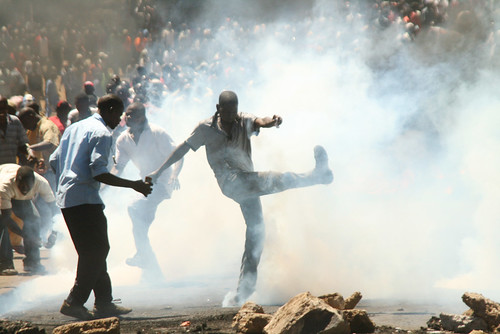
Before even talking about the current Constitutional battles, it's important to put the 2007 violence in context.
Kenyan politics are different from those in many countries. As one of my Kenyan colleagues pointed out, it's impossible to peg political leaders as left-wing or right-wing, progressive or conservative, traditional or modern. Although national politicians have views on particular issues -- education, trade, healthcare, housing, crime -- their positions don't really affect their voter base. Rather, political affiliations in Kenya are almost exclusively tribal. Kenyan politicians have an infamous and unfortunate track record of diverting public resources to their own -- or affiliated -- ethnic groups. Analysts have noted, for instance, that when control of the Presidency shifts from one group to another, funding to schools and hospitals in geographic areas populated by opponent ethnic groups tended to drop significantly. In light of such practices, it's easy to see how Kenyans could be very skeptical about politics and about the validity of their leaders' intentions. As a result of the patronage politics, elections (especially Presidential elections) are extremely high stakes. If your candidate wins, educated partisan cronies can expect plum jobs and the common follower can look forward to increased funding for public services. If he loses, however, they can predict that resources will be diverted to ethnic groups that backed the winner. A lot of this is described in Michaela Wrong's bestseller "It's Our Turn to Eat" -- http://www.amazon.co.uk/Its-Our-Turn-Michela-Wrong/dp/0007241968.
Combine high-stakes, patronage politics with endemic campaign corruption* and voter fraud and you can a lot of angry people at the polls.
It's an easy contrast with Tanzania, which has a drastically different political environment. Tanzania's post-independence leader, Julius Nyerere, had a very different vision for his country that his Kenyan contemporary Jomo Kenyatta. Nyerere had communistic ideals and believed that the natural mode of living for sub-Saharan Africans was a traditional, communal, family-centered village. He believed that the ideal economic mode of production was also the commune, a strategy which was not particularly effective for increasing agricultural output. Nyerere also stressed national unity - he oversaw the unification of Tanganyika and Zanzibar into modern-day Tanzania, promoted the use of Kiswahili as the official national language, and encouraged national Tanzanian identity over ethnic-tribal identities such as the Sukuma, Yao or Suba**.
If it's hard to say which approach is better, it seems obvious that the differences in vision between Jomo and Julius produced a real divergence between their countries. In Kenya, politics is contentious, tribal and high-stakes; in Tanzania, a single party - C.C.M. - has ruled the country since independence and political battles take place (when at all) around local parliamentary elections. In Kenya, people feel strong tribal identities and prefer to speak their native tongue or English (which they can do well); Tanzanians have embraced Swahili as a lingua franca but generally can't speak English well. Kenyans are (as a rule) entrepreneurial, competitive and trade-oriented; Tanzanians are more relaxed, more trapped by red tape and high tariffs, and less competitive within the region. Kenya performs significantly worse than Tanzania in terms of wealth and income inequality. (On land inequality: three families in Kenya each own 1 million acres of land. On income inequality: as measured by the UN's Gini coefficient index, a widely accepted indicator of income inequality, Tanzania has a 34.6 - in between France and Australia - while Kenya gets a 47.7, meaning that income distribution is more unequal than in the United States, and almost as unequal as Brazil).
Thanks to its more commercial orientation, Kenya seems to have come out ahead of Tanzania economically. In terms of politics, though, Kenya seems to have it bad: ethnic tension, tribal identities which override national unity and debate of issues, endemic corruption and substantial inequality in both land holding and income. As a function of these structural problems, political decisions (such as elections) can lead to violent results, often along ethnic lines.
Now that Kenya is moving full swing into the national referendum to approve the new Constitution, who knows how things will shake out? The Constitution contains the usual sorts of provisions found in constitutions drafted since World War II. There are the usual things related to the branches of government, stronger separation powers, the right to vote, to free speech, etc. These aren't controversial. Like many African constitutions, this one protects so-called "second generation" or "affirmative" rights: healthcare, education, housing, fair wages, culture, and family life, among others. Although it's unlikely that the Government of Kenya could actually provide all those rights, no one is going to object to that sort of language.
Three parts of the Constitution have been the source of debate:
- Abortion. Abortion is currently illegal in Kenya and you can go to jail to performing one or undertaking one. The Constitution officially outlaws abortion but provides for a number of open-ended exceptions that many conservatives (primarily Catholics) think will increase access to abortions in Kenya.
- Kadhi (Islamic) courts. The Constitution provides for the official establishment of Kadhi, or Islamic courts in Muslim areas. It also provides for exceptions to certain provisions of the Bill of Rights for professed Muslims. Although Kadhi courts currently exist (with statutory, rather than Constitutional backing), you can imagine that this has pissed off the Christian set.

- Land. It's a little unclear what Chapter Five actually means for land reform, but the section is widely understood to mean that the Constitution empowers government to ensure equitable distribution of land, including reversing some illegitimate purchases (land grabbing) that go back to the post-independence period. Because Kenya has such uneven land distribution, this is of major concern to landholders in the Rift Valley who stand to lose a lot if their sketchy land deals get investigated and possibly invalidated. As a result, Daniel arap Moi and his cronies have been telling Nairobians that if the Constitution passes, Maasai herders will come and seize all their land. Some people actually believe this.
But it's not just the major points of debate that pose problems. Getting a country of almost 40 million people, many of whom don't speak English and have limited schooling (let alone legal education), to understand a massive documents with hundreds of parts is an insurmountable task. As my driver yesterday, Peter, pointed out, he speaks English fluently but doesn't have the legal education to understand what the provisions really mean. ("If you have not been trained in the law, how can you know what this really means?"; "What does it mean if [the Constitution] says 'the government shall do something'? That's in the future."). Of course, there are people on both sides of the debate constantly telling him what it means, but he doesn't trust what they say. So even though he has read parts of the Constitution, he's not even sure he will vote in the end. Peter was most worried about his old grandmother in the village, who doesn't see well and can't speak English; he's concerned that if she tries to vote, the people at the polling station might trick her into picking something she doesn't want. Getting to the polling station is only half the battle.
All the issues inherent in the Constitutional referendum - the high-stakes outcomes, the propaganda, the lack of understanding of its contents, the underlying ethnic tensions - are going to make for an interesting vote next Wednesday. I just hope that no one gets hurt.
* Corruption is generally bad. Transparency International gave Kenya a corruption ranking of 146 out of 180 in 2009. This put it on par with Russia, Zimbabwe and Ecuador.
** There is one notable exception to the unity and uniformity of Tanzania - Zanzibar, which has courts with the jurisdiction to hear Islamic law claims and whose residents tend to vote for minority political parties such as the C.U.F. The Zanzibari exceptionalism enshrined in Tanzania's legal structure stems from the negotiations that took place at the time of union between Zanzibar and Tanganyika, theoretically a merger of two equal sovereign states. It's similar to special legal treatment for Texas or Quebec.
*** For a copy of the draft Constitution, click here: http://muigwithania.com/2010/05/05/kenyan-constitution-pdf/. Warning: it's long.
Subscribe to:
Posts (Atom)
