Showing posts with label constitution. Show all posts

Wednesday, 1 September 2010

Kneeling Before Ngai

On Monday evening, I arrived back from a four-day hiking trip to Mount Kenya, the second-highest mountain in Africa*. A group of friends and I decided to summit Lenana, the third highest peak on the mountain (4,985 meters) and the highest peak accessible to non-technical climbers. Our guide was Will Wamaru, an excellent and experienced guide who recently opened launched his own travel company.

Mount Kenya is a sacred mountain for many Kenyans. Several ethnic groups from the Central Highlands - the Meru, the Maasai and the Gikuyu - believe that the mountain is the home of Ngai, the supreme god and creator of the world. Jomo Kenyatta, Kenya's first President, wrote a book, Facing Mount Kenya, which details the Gikuyu relationship with the mountain and Central Highlands culture.

This was an auspicious weekend to climb the mountain. Earlier this month, Kenyans population voted overwhelmingly in favor of a new national Constitution. Although we hadn't planned it that way, Friday (the day we began our ascent) was the day when the President, Vice-President and Prime Minister of Kenya formally "promulgated" the document and put into effect the Second Republic. Partly because current President Kibaki is Gikuyu, and partly out of Kenyan national pride, a small team of local climbers carried a copy of the Constitution to Lenana peak immediately after the signing. Because of the number of tourists on the mountain and the time we left, we stood to be among the first forty foreigners to see the special copy on top of Mount Kenya.

Of course, there's a catch: the whole climbing thing.

The obvious thing to write here is that the hike was wonderful: a pleasantly rugged trek, with a smiling, pink-cheeked Al marveling at the views from the summit and reveling in the achievement of getting to the top. But I won't lie: it was physically exhausting and, for at least a day, miserable.

The first day was fine. It was just a four-hour climb through light rain on a gravelly road, covering roughly 600 vertical meters. The first lodge we stayed at was similarly decent: a bit wet, but the food was great and the bunkbed dorm was fairly comfortable. I realized that we could have been in tents.

The second day was much tougher: a nine-hour climb through mostly decent weather, covering 900 vertical meters. We had to cross a number of ridges and some very swampy terrain, so there were a lot of ups and downs. Still, it was about 100 meters an hour in terms of vertical climb, which didn't sound awful to me.

I was doing very well until lunch when I got hit with altitude sickness all of a sudden. It's difficult to predict its symptoms for each person, but almost everyone in our group got it in one form or another. For me, it started as an intense headache, which I assumed was similar to a migraine. My temples throbbed, my head hurt and I felt a bit dizzy. As we got above 4,000 meters (2.5 miles), my breathing became very labored and I started coughing a lot. The rest of the group were facing similar things, so our pace slowed quite a bit.

The big advantage to the second day was seeing major shifts in climate and vegetation. Even at higher altitude, there's lots of interesting fauna as well: rock and tree Hyraxes (a sort of fat capybara-like thing related to an elephant); colobus monkeys; big grey monkeys that like to steal; lone buffaloes; crested eagles and buzzards.


The lodge at the second night was not a pleasant experience. I didn't have much of an appetite, although I did eat after taking half of a friend's Diamox, an altitude-sickness medicine. When I tried to sleep, I couldn't do it at first. I also had strange chills even though I could feel that my skin was hot. Weird! But in the end (probably thanks to the Diamox), I managed to fall asleep around 11 pm.


Before long, it was 2 am - time to get up for summit day. Our guide's biggest mistake was probably telling us that the final ascent would be easier than the previous day...

It was not. Whereas Day 2 involved a climb of 100 meters per hour (with an average altitude of 3,700), the summit climb involved a climb of 200 vertical meters per hour (at an average of 4,600 meters above sea level). This does not sound like much, but if you take into account safety stops, it turns into about 4 meters (vertical) per minute when you're actually climbing. At a high altitude, when hiking on ice or scree, this is pretty fast. By around 4 am, our conversation had stopped completely. We were like a team of foreign zombies trudging up the mountainside in the darkness. Or something.

After four hours we reached Lenana peak. It was pretty cool: a frozen Kenyan flag, some plaques of people that died, and a brand new glass-metal-clay shrine to the Second Republic, copy of the Constitution inside. We were probably among the first couple of dozen people ever to have seen it there.


Equally (ok, more) enjoyable, was a prank I played on John, one of the guys in our group. Some of you will already be familiar with the viral drinking phenomenon of "Bros Icing Bros." As those of you who are/were/know a 17-19 year old girl are aware, Smirnoff Ice is a sugary, lightly alcoholic, bottled drink (or alcopop) consumed almost exclusively by members of that demographic group.

But thanks to the recent Icing phenomenon, however, it has become normal for guys to foist a bottle of Smirnoff Ice on an unsuspecting friend/bro, who must then get down on one knee and drink the entire bottle in one go. There are variations on the rules - see http://en.wikipedia.org/wiki/Icing_(drinking_game) - but that's the gist. I managed to present John with a nearly-frozen Ice right in front of the Constitution, surely the first of its kind in the annals of Icing history.


After such Smirnoff summit shenanigans were over, we had to descend down a treacherous ice ridge to get off the peak. Later in the day, Will mentioned that a young American woman on one of his trips had died after slipping down the ice. I'm glad he mentioned that after, or I would have felt pretty nervous about the ice. And the Ice, for that matter.

The ice ridge took about an hour to get down, after which point we had another 3-hour descent to breakfast. Part of this involved an awesome scree slope that you could sprint down since it was so soft and gravelly - a great way to knock off 300 vertical meters of thin air in a half hour. This is me resting (in the orange) before the scree part:


After breakfast, a quick nap, and lunch, we had to hike for a further 8 hours through what was described as the "vertical bog." This essentially involved a trek through a muddy creek for many hours, about 3 of which we walked in the dark. The reward for the muddy trudging was our final camp, which was at a breathable 3,000-ish meters and had a very cozy bunk bed setup. I've never slept so well in my life.


Even one day after getting back, I am already starting to re-write the more grueling parts of the experience in my head. Only my right shoulder, quads and calves remind me that, while a good time with great people, it wasn't a bed of high-altitude roses.

Overall, it was a good experience, though: the food, the excellent company, the Smirnoff-related antics and the timing of our trip were all big pluses to the weekend. Nonetheless, I don't think that I'll plan on climbing any 4,000+ meter peaks in the near future.

But don't quote me on that.

* Accordingly to Wikipedia, the second-highest peak on each continent is more challenging than the tallest peak. As a result, the "Seven Summits" (the tallest peaks on each continent) have been completed by a number of experts, but the "Seven Second Summits" have not. Mount Kenya's technical summit (not the one I climbed) is one of the Seven Second Summits and is considerably harder than Kilimanjaro's Uhuru Peak, which is generally doable for tourists. http://en.wikipedia.org/wiki/Seven_Second_Summits

Photographs courtesy of Jane Del Ser and Charlene Chen.

Monday, 26 July 2010

Reconstitution

I arrived in Nairobi at an interesting time for Kenyan politics. On August 4th, the Kenyan people will vote in a national referendum to decide whether to adopt a new draft Constitution.

Nairobi is buzzing with talk abour the vote: billboards (mostly pro-Yes) are everywhere, senior government officials have left to lead rallies in the countryside, radio shows talk about it constantly, and people debate the pros and cons of the new document. I talk with Kenyans about the Constitution many times each day. Most have strong reasons for or against it, but very few are willing to predict the sort of civil unrest that the vote with cause.

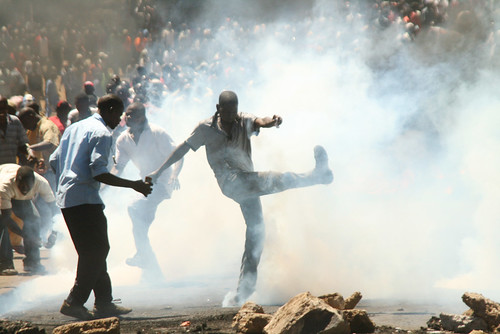
You might remember the ugly post-election violence in Kenya in 2007. Following the official declaration that Mwai Kibaki had won the Presidential election, ethnic groups allied with the insurgent (current Prime Minister) Raila Odinga staged a large number of non-violent and violent protests. They complained that the other side has rigged the election, a charge echoed by most international observers. The violence took different shapes in different parts of the country, with ethnic minorities from one party's camp being harrassed and attacked in areas dominated by ethnic groups aligned with the other candidate. The violence finally abated when Kibaki's and Odinga's factions agreed to an extra-Constitutional power sharing agreement with Kibaki as President and Odinga as Prime Minister. This arrangement was novel, but it was accepted by the courts primarily as a means to end the violence. As the conflict settled down, hundreds had been killed, thousands injured and tens of thousands displaced from their homes, particularly in slum areas of Nairboi such as Kibera.


Before even talking about the current Constitutional battles, it's important to put the 2007 violence in context.

Kenyan politics are different from those in many countries. As one of my Kenyan colleagues pointed out, it's impossible to peg political leaders as left-wing or right-wing, progressive or conservative, traditional or modern. Although national politicians have views on particular issues -- education, trade, healthcare, housing, crime -- their positions don't really affect their voter base. Rather, political affiliations in Kenya are almost exclusively tribal. Kenyan politicians have an infamous and unfortunate track record of diverting public resources to their own -- or affiliated -- ethnic groups. Analysts have noted, for instance, that when control of the Presidency shifts from one group to another, funding to schools and hospitals in geographic areas populated by opponent ethnic groups tended to drop significantly. In light of such practices, it's easy to see how Kenyans could be very skeptical about politics and about the validity of their leaders' intentions. As a result of the patronage politics, elections (especially Presidential elections) are extremely high stakes. If your candidate wins, educated partisan cronies can expect plum jobs and the common follower can look forward to increased funding for public services. If he loses, however, they can predict that resources will be diverted to ethnic groups that backed the winner. A lot of this is described in Michaela Wrong's bestseller "It's Our Turn to Eat" -- http://www.amazon.co.uk/Its-Our-Turn-Michela-Wrong/dp/0007241968.

Combine high-stakes, patronage politics with endemic campaign corruption* and voter fraud and you can a lot of angry people at the polls.

It's an easy contrast with Tanzania, which has a drastically different political environment. Tanzania's post-independence leader, Julius Nyerere, had a very different vision for his country that his Kenyan contemporary Jomo Kenyatta. Nyerere had communistic ideals and believed that the natural mode of living for sub-Saharan Africans was a traditional, communal, family-centered village. He believed that the ideal economic mode of production was also the commune, a strategy which was not particularly effective for increasing agricultural output. Nyerere also stressed national unity - he oversaw the unification of Tanganyika and Zanzibar into modern-day Tanzania, promoted the use of Kiswahili as the official national language, and encouraged national Tanzanian identity over ethnic-tribal identities such as the Sukuma, Yao or Suba**.

If it's hard to say which approach is better, it seems obvious that the differences in vision between Jomo and Julius produced a real divergence between their countries. In Kenya, politics is contentious, tribal and high-stakes; in Tanzania, a single party - C.C.M. - has ruled the country since independence and political battles take place (when at all) around local parliamentary elections. In Kenya, people feel strong tribal identities and prefer to speak their native tongue or English (which they can do well); Tanzanians have embraced Swahili as a lingua franca but generally can't speak English well. Kenyans are (as a rule) entrepreneurial, competitive and trade-oriented; Tanzanians are more relaxed, more trapped by red tape and high tariffs, and less competitive within the region. Kenya performs significantly worse than Tanzania in terms of wealth and income inequality. (On land inequality: three families in Kenya each own 1 million acres of land. On income inequality: as measured by the UN's Gini coefficient index, a widely accepted indicator of income inequality, Tanzania has a 34.6 - in between France and Australia - while Kenya gets a 47.7, meaning that income distribution is more unequal than in the United States, and almost as unequal as Brazil).

Thanks to its more commercial orientation, Kenya seems to have come out ahead of Tanzania economically. In terms of politics, though, Kenya seems to have it bad: ethnic tension, tribal identities which override national unity and debate of issues, endemic corruption and substantial inequality in both land holding and income. As a function of these structural problems, political decisions (such as elections) can lead to violent results, often along ethnic lines.

Now that Kenya is moving full swing into the national referendum to approve the new Constitution, who knows how things will shake out? The Constitution contains the usual sorts of provisions found in constitutions drafted since World War II. There are the usual things related to the branches of government, stronger separation powers, the right to vote, to free speech, etc. These aren't controversial. Like many African constitutions, this one protects so-called "second generation" or "affirmative" rights: healthcare, education, housing, fair wages, culture, and family life, among others. Although it's unlikely that the Government of Kenya could actually provide all those rights, no one is going to object to that sort of language.

Three parts of the Constitution have been the source of debate:
- Abortion. Abortion is currently illegal in Kenya and you can go to jail to performing one or undertaking one. The Constitution officially outlaws abortion but provides for a number of open-ended exceptions that many conservatives (primarily Catholics) think will increase access to abortions in Kenya.
- Kadhi (Islamic) courts. The Constitution provides for the official establishment of Kadhi, or Islamic courts in Muslim areas. It also provides for exceptions to certain provisions of the Bill of Rights for professed Muslims. Although Kadhi courts currently exist (with statutory, rather than Constitutional backing), you can imagine that this has pissed off the Christian set.


- Land. It's a little unclear what Chapter Five actually means for land reform, but the section is widely understood to mean that the Constitution empowers government to ensure equitable distribution of land, including reversing some illegitimate purchases (land grabbing) that go back to the post-independence period. Because Kenya has such uneven land distribution, this is of major concern to landholders in the Rift Valley who stand to lose a lot if their sketchy land deals get investigated and possibly invalidated. As a result, Daniel arap Moi and his cronies have been telling Nairobians that if the Constitution passes, Maasai herders will come and seize all their land. Some people actually believe this.

But it's not just the major points of debate that pose problems. Getting a country of almost 40 million people, many of whom don't speak English and have limited schooling (let alone legal education), to understand a massive documents with hundreds of parts is an insurmountable task. As my driver yesterday, Peter, pointed out, he speaks English fluently but doesn't have the legal education to understand what the provisions really mean. ("If you have not been trained in the law, how can you know what this really means?"; "What does it mean if [the Constitution] says 'the government shall do something'? That's in the future."). Of course, there are people on both sides of the debate constantly telling him what it means, but he doesn't trust what they say. So even though he has read parts of the Constitution, he's not even sure he will vote in the end. Peter was most worried about his old grandmother in the village, who doesn't see well and can't speak English; he's concerned that if she tries to vote, the people at the polling station might trick her into picking something she doesn't want. Getting to the polling station is only half the battle.

All the issues inherent in the Constitutional referendum - the high-stakes outcomes, the propaganda, the lack of understanding of its contents, the underlying ethnic tensions - are going to make for an interesting vote next Wednesday. I just hope that no one gets hurt.

* Corruption is generally bad. Transparency International gave Kenya a corruption ranking of 146 out of 180 in 2009. This put it on par with Russia, Zimbabwe and Ecuador.

** There is one notable exception to the unity and uniformity of Tanzania - Zanzibar, which has courts with the jurisdiction to hear Islamic law claims and whose residents tend to vote for minority political parties such as the C.U.F. The Zanzibari exceptionalism enshrined in Tanzania's legal structure stems from the negotiations that took place at the time of union between Zanzibar and Tanganyika, theoretically a merger of two equal sovereign states. It's similar to special legal treatment for Texas or Quebec.

*** For a copy of the draft Constitution, click here: http://muigwithania.com/2010/05/05/kenyan-constitution-pdf/. Warning: it's long.