Well, folks, my time in Nairobi has come to an end. I'm writing this one from Dulles Airport on my way back to Cambridge! (It seems a little anti-climactic, I know, to write a final blog post after leaving Kenya. But my power was out all day Friday, so I had no choice.)
The past eight weeks have flown by quickly. I think this is partly because of the excitement of being in a new place, and partly because I've been traveling so much within the region. The past four weeks have especially been a blur: a hike up Mount Kenya, trips to Burundi, Rwanda and Tanzania, and meetings all over the place.
In the end, living in Nairobi has come as a pleasant surprise: I like it there now. Initially, I didn't. The traffic, pollution, fear of crime, and utter lack of charm all added up to a crappy first impression. But since then, the city grew on me. The food has been a major plus (Japanese! Ethiopian! French!), as have the benefits of Swahili-only-when-you-feel-like-it. Meeting other people has probably been the best part, though. This city is full of great, warm people doing fascinating and important work in areas I find interesting - politics, international development, reporting, impact investing and social enterprise. The people I spend time with outside of work are uniformly passionate about what they do, which I find refreshing and inspiring at the same time. And I've made some good friends.
My work has also been pretty positive overall. My team at the IFC gave me a lot of responsibility and some very interesting projects to work on. I'm glad to have played an early role in shaping the East African Community's common market strategy, a political and economic goal that I really believe in. It's been especially interesting traveling to the EAC capitals to meet with officials there. The development challenges and preoccupations of the five member states couldn't be more different, from creepily efficient Rwanda to backwards-and-we-know-it Burundi. On top of the work itself, I've really had fun with my coworkers - they're smart, welcoming and talented people. They've taught me a lot about avoiding, flattering, convincing and otherwise dealing with difficult public officials and antagonistic clients - I hope I've picked up some of that from them. The team even threw me a very nice sendoff lunch at my favorite place on Thursday, which I thought was a nice gesture.
Although I'm sad to have left, I have two great things to look forward to right away. Tomorrow, I'm going to the wedding of two good friends in Cambridge, then I'm visiting the beautiful Stephanie in San Francisco. The expectation of things to come was almost enough to dull the pain of tonight's 30-something hour journey back to Massachusetts (although it does not remedy the sad fact that I watched Prince of Persia to stave off in-flight boredom.)
So this will be the last Tanzlines post for a while. In terms of exciting African adventures ahead, the next one will probably be next January in southern Africa. Hang tight until then!
Showing posts with label Kenya. Show all posts
Showing posts with label Kenya. Show all posts
Saturday, 11 September 2010

Wednesday, 1 September 2010
Kneeling Before Ngai
On Monday evening, I arrived back from a four-day hiking trip to Mount Kenya, the second-highest mountain in Africa*. A group of friends and I decided to summit Lenana, the third highest peak on the mountain (4,985 meters) and the highest peak accessible to non-technical climbers. Our guide was Will Wamaru, an excellent and experienced guide who recently opened launched his own travel company.
Mount Kenya is a sacred mountain for many Kenyans. Several ethnic groups from the Central Highlands - the Meru, the Maasai and the Gikuyu - believe that the mountain is the home of Ngai, the supreme god and creator of the world. Jomo Kenyatta, Kenya's first President, wrote a book, Facing Mount Kenya, which details the Gikuyu relationship with the mountain and Central Highlands culture.
This was an auspicious weekend to climb the mountain. Earlier this month, Kenyans population voted overwhelmingly in favor of a new national Constitution. Although we hadn't planned it that way, Friday (the day we began our ascent) was the day when the President, Vice-President and Prime Minister of Kenya formally "promulgated" the document and put into effect the Second Republic. Partly because current President Kibaki is Gikuyu, and partly out of Kenyan national pride, a small team of local climbers carried a copy of the Constitution to Lenana peak immediately after the signing. Because of the number of tourists on the mountain and the time we left, we stood to be among the first forty foreigners to see the special copy on top of Mount Kenya.
Of course, there's a catch: the whole climbing thing.
The obvious thing to write here is that the hike was wonderful: a pleasantly rugged trek, with a smiling, pink-cheeked Al marveling at the views from the summit and reveling in the achievement of getting to the top. But I won't lie: it was physically exhausting and, for at least a day, miserable.
The first day was fine. It was just a four-hour climb through light rain on a gravelly road, covering roughly 600 vertical meters. The first lodge we stayed at was similarly decent: a bit wet, but the food was great and the bunkbed dorm was fairly comfortable. I realized that we could have been in tents.
The second day was much tougher: a nine-hour climb through mostly decent weather, covering 900 vertical meters. We had to cross a number of ridges and some very swampy terrain, so there were a lot of ups and downs. Still, it was about 100 meters an hour in terms of vertical climb, which didn't sound awful to me.
I was doing very well until lunch when I got hit with altitude sickness all of a sudden. It's difficult to predict its symptoms for each person, but almost everyone in our group got it in one form or another. For me, it started as an intense headache, which I assumed was similar to a migraine. My temples throbbed, my head hurt and I felt a bit dizzy. As we got above 4,000 meters (2.5 miles), my breathing became very labored and I started coughing a lot. The rest of the group were facing similar things, so our pace slowed quite a bit.
The big advantage to the second day was seeing major shifts in climate and vegetation. Even at higher altitude, there's lots of interesting fauna as well: rock and tree Hyraxes (a sort of fat capybara-like thing related to an elephant); colobus monkeys; big grey monkeys that like to steal; lone buffaloes; crested eagles and buzzards.

The lodge at the second night was not a pleasant experience. I didn't have much of an appetite, although I did eat after taking half of a friend's Diamox, an altitude-sickness medicine. When I tried to sleep, I couldn't do it at first. I also had strange chills even though I could feel that my skin was hot. Weird! But in the end (probably thanks to the Diamox), I managed to fall asleep around 11 pm.

Before long, it was 2 am - time to get up for summit day. Our guide's biggest mistake was probably telling us that the final ascent would be easier than the previous day...
It was not. Whereas Day 2 involved a climb of 100 meters per hour (with an average altitude of 3,700), the summit climb involved a climb of 200 vertical meters per hour (at an average of 4,600 meters above sea level). This does not sound like much, but if you take into account safety stops, it turns into about 4 meters (vertical) per minute when you're actually climbing. At a high altitude, when hiking on ice or scree, this is pretty fast. By around 4 am, our conversation had stopped completely. We were like a team of foreign zombies trudging up the mountainside in the darkness. Or something.
After four hours we reached Lenana peak. It was pretty cool: a frozen Kenyan flag, some plaques of people that died, and a brand new glass-metal-clay shrine to the Second Republic, copy of the Constitution inside. We were probably among the first couple of dozen people ever to have seen it there.

Equally (ok, more) enjoyable, was a prank I played on John, one of the guys in our group. Some of you will already be familiar with the viral drinking phenomenon of "Bros Icing Bros." As those of you who are/were/know a 17-19 year old girl are aware, Smirnoff Ice is a sugary, lightly alcoholic, bottled drink (or alcopop) consumed almost exclusively by members of that demographic group.
But thanks to the recent Icing phenomenon, however, it has become normal for guys to foist a bottle of Smirnoff Ice on an unsuspecting friend/bro, who must then get down on one knee and drink the entire bottle in one go. There are variations on the rules - see http://en.wikipedia.org/wiki/Icing_(drinking_game) - but that's the gist. I managed to present John with a nearly-frozen Ice right in front of the Constitution, surely the first of its kind in the annals of Icing history.

After such Smirnoff summit shenanigans were over, we had to descend down a treacherous ice ridge to get off the peak. Later in the day, Will mentioned that a young American woman on one of his trips had died after slipping down the ice. I'm glad he mentioned that after, or I would have felt pretty nervous about the ice. And the Ice, for that matter.
The ice ridge took about an hour to get down, after which point we had another 3-hour descent to breakfast. Part of this involved an awesome scree slope that you could sprint down since it was so soft and gravelly - a great way to knock off 300 vertical meters of thin air in a half hour. This is me resting (in the orange) before the scree part:

After breakfast, a quick nap, and lunch, we had to hike for a further 8 hours through what was described as the "vertical bog." This essentially involved a trek through a muddy creek for many hours, about 3 of which we walked in the dark. The reward for the muddy trudging was our final camp, which was at a breathable 3,000-ish meters and had a very cozy bunk bed setup. I've never slept so well in my life.

Even one day after getting back, I am already starting to re-write the more grueling parts of the experience in my head. Only my right shoulder, quads and calves remind me that, while a good time with great people, it wasn't a bed of high-altitude roses.
Overall, it was a good experience, though: the food, the excellent company, the Smirnoff-related antics and the timing of our trip were all big pluses to the weekend. Nonetheless, I don't think that I'll plan on climbing any 4,000+ meter peaks in the near future.
But don't quote me on that.
* Accordingly to Wikipedia, the second-highest peak on each continent is more challenging than the tallest peak. As a result, the "Seven Summits" (the tallest peaks on each continent) have been completed by a number of experts, but the "Seven Second Summits" have not. Mount Kenya's technical summit (not the one I climbed) is one of the Seven Second Summits and is considerably harder than Kilimanjaro's Uhuru Peak, which is generally doable for tourists. http://en.wikipedia.org/wiki/Seven_Second_Summits
Photographs courtesy of Jane Del Ser and Charlene Chen.
Mount Kenya is a sacred mountain for many Kenyans. Several ethnic groups from the Central Highlands - the Meru, the Maasai and the Gikuyu - believe that the mountain is the home of Ngai, the supreme god and creator of the world. Jomo Kenyatta, Kenya's first President, wrote a book, Facing Mount Kenya, which details the Gikuyu relationship with the mountain and Central Highlands culture.
This was an auspicious weekend to climb the mountain. Earlier this month, Kenyans population voted overwhelmingly in favor of a new national Constitution. Although we hadn't planned it that way, Friday (the day we began our ascent) was the day when the President, Vice-President and Prime Minister of Kenya formally "promulgated" the document and put into effect the Second Republic. Partly because current President Kibaki is Gikuyu, and partly out of Kenyan national pride, a small team of local climbers carried a copy of the Constitution to Lenana peak immediately after the signing. Because of the number of tourists on the mountain and the time we left, we stood to be among the first forty foreigners to see the special copy on top of Mount Kenya.
Of course, there's a catch: the whole climbing thing.
The obvious thing to write here is that the hike was wonderful: a pleasantly rugged trek, with a smiling, pink-cheeked Al marveling at the views from the summit and reveling in the achievement of getting to the top. But I won't lie: it was physically exhausting and, for at least a day, miserable.
The first day was fine. It was just a four-hour climb through light rain on a gravelly road, covering roughly 600 vertical meters. The first lodge we stayed at was similarly decent: a bit wet, but the food was great and the bunkbed dorm was fairly comfortable. I realized that we could have been in tents.
The second day was much tougher: a nine-hour climb through mostly decent weather, covering 900 vertical meters. We had to cross a number of ridges and some very swampy terrain, so there were a lot of ups and downs. Still, it was about 100 meters an hour in terms of vertical climb, which didn't sound awful to me.
I was doing very well until lunch when I got hit with altitude sickness all of a sudden. It's difficult to predict its symptoms for each person, but almost everyone in our group got it in one form or another. For me, it started as an intense headache, which I assumed was similar to a migraine. My temples throbbed, my head hurt and I felt a bit dizzy. As we got above 4,000 meters (2.5 miles), my breathing became very labored and I started coughing a lot. The rest of the group were facing similar things, so our pace slowed quite a bit.
The big advantage to the second day was seeing major shifts in climate and vegetation. Even at higher altitude, there's lots of interesting fauna as well: rock and tree Hyraxes (a sort of fat capybara-like thing related to an elephant); colobus monkeys; big grey monkeys that like to steal; lone buffaloes; crested eagles and buzzards.

The lodge at the second night was not a pleasant experience. I didn't have much of an appetite, although I did eat after taking half of a friend's Diamox, an altitude-sickness medicine. When I tried to sleep, I couldn't do it at first. I also had strange chills even though I could feel that my skin was hot. Weird! But in the end (probably thanks to the Diamox), I managed to fall asleep around 11 pm.

Before long, it was 2 am - time to get up for summit day. Our guide's biggest mistake was probably telling us that the final ascent would be easier than the previous day...
It was not. Whereas Day 2 involved a climb of 100 meters per hour (with an average altitude of 3,700), the summit climb involved a climb of 200 vertical meters per hour (at an average of 4,600 meters above sea level). This does not sound like much, but if you take into account safety stops, it turns into about 4 meters (vertical) per minute when you're actually climbing. At a high altitude, when hiking on ice or scree, this is pretty fast. By around 4 am, our conversation had stopped completely. We were like a team of foreign zombies trudging up the mountainside in the darkness. Or something.
After four hours we reached Lenana peak. It was pretty cool: a frozen Kenyan flag, some plaques of people that died, and a brand new glass-metal-clay shrine to the Second Republic, copy of the Constitution inside. We were probably among the first couple of dozen people ever to have seen it there.

Equally (ok, more) enjoyable, was a prank I played on John, one of the guys in our group. Some of you will already be familiar with the viral drinking phenomenon of "Bros Icing Bros." As those of you who are/were/know a 17-19 year old girl are aware, Smirnoff Ice is a sugary, lightly alcoholic, bottled drink (or alcopop) consumed almost exclusively by members of that demographic group.
But thanks to the recent Icing phenomenon, however, it has become normal for guys to foist a bottle of Smirnoff Ice on an unsuspecting friend/bro, who must then get down on one knee and drink the entire bottle in one go. There are variations on the rules - see http://en.wikipedia.org/wiki/Icing_(drinking_game) - but that's the gist. I managed to present John with a nearly-frozen Ice right in front of the Constitution, surely the first of its kind in the annals of Icing history.

After such Smirnoff summit shenanigans were over, we had to descend down a treacherous ice ridge to get off the peak. Later in the day, Will mentioned that a young American woman on one of his trips had died after slipping down the ice. I'm glad he mentioned that after, or I would have felt pretty nervous about the ice. And the Ice, for that matter.
The ice ridge took about an hour to get down, after which point we had another 3-hour descent to breakfast. Part of this involved an awesome scree slope that you could sprint down since it was so soft and gravelly - a great way to knock off 300 vertical meters of thin air in a half hour. This is me resting (in the orange) before the scree part:

After breakfast, a quick nap, and lunch, we had to hike for a further 8 hours through what was described as the "vertical bog." This essentially involved a trek through a muddy creek for many hours, about 3 of which we walked in the dark. The reward for the muddy trudging was our final camp, which was at a breathable 3,000-ish meters and had a very cozy bunk bed setup. I've never slept so well in my life.

Even one day after getting back, I am already starting to re-write the more grueling parts of the experience in my head. Only my right shoulder, quads and calves remind me that, while a good time with great people, it wasn't a bed of high-altitude roses.
Overall, it was a good experience, though: the food, the excellent company, the Smirnoff-related antics and the timing of our trip were all big pluses to the weekend. Nonetheless, I don't think that I'll plan on climbing any 4,000+ meter peaks in the near future.
But don't quote me on that.
* Accordingly to Wikipedia, the second-highest peak on each continent is more challenging than the tallest peak. As a result, the "Seven Summits" (the tallest peaks on each continent) have been completed by a number of experts, but the "Seven Second Summits" have not. Mount Kenya's technical summit (not the one I climbed) is one of the Seven Second Summits and is considerably harder than Kilimanjaro's Uhuru Peak, which is generally doable for tourists. http://en.wikipedia.org/wiki/Seven_Second_Summits
Photographs courtesy of Jane Del Ser and Charlene Chen.
Sunday, 22 August 2010
Acausted
This weekend, I took a trip with friends to the Great Rift Valley. The Rift Valley has been on my list for some time. It’s famous for national parks, game drives, spectacular views and some of the world’s most famous archeological sites with early Cro-Magnon fossils (including the famous Olduvai Gorge). The Kenyan Rift Valley is also a politically charged area: it was a hotbed of violence during the last Presidential election and was the only area firmly opposed to the new Constitution in this month's referendum.
But this weekend was all about the animals. Our trip included two mini-safaris: a walking safari on Crescent Island and a game drive in Nakuru National Park.
I had never done a walking safari before, but it was a cool experience. Crescent Island has no predators, so it’s safe to walk around and track down animals on foot. There are giraffes, hippos, zebras, a number of gazelle-like things, wildebeest and water buffalo.
The main advantage of a walking safari is that you can approach the animals on foot and generally interact with (read: harass) the various creatures. The highlight of the harassment was chasing a giraffe, some wildebeest and a small group of zebra. I learned that every animal there can run twice as fast as a sprinting human. I’m glad we’re not early Cro-Magnon hunters anymore. Or gatherers, for that matter. Here, tracking the animals:

On Saturday night we stayed at Maili Saba Tented Camp, a luxurious facility whose accommodation only loosely qualifies as “camping.” Instead of sleeping in normal tents on lumpy ground, Maili Saba is equipped with permanent luxury tents on platforms that contain large, comfortable beds covered with fresh white linens. Each tent has its own porch, hot shower and clean toilet, plus electric lighting installed into converted kerosene lanterns. The Camp is perched on the edge of a bluff overlooking the valley, so the views are spectacular.

As people who read my Ghana posts will know, I am currently migrating from the hostels-and-backpack phase of my life into the budget-hotels-and-rolling-luggage phase of my life. I guess I’m simply willing to pay a little more for the nicer touches.

After breakfast, we left with our guide to Nakuru National Park. Nakuru is one of two “premium parks” run by Kenya Wildlife Services, meaning that the animals are more interesting and the prices are higher. Nakuru is particularly famous for its abundant bird life and the presence of both black rhinos and the rarer white rhinos. I am not an ornithophile, but the birds at Nakuru were terrific: foul vulture-like Marabou Storks, giant flocks of flamingos and other exotic avian life whose names I’ve already forgotten (the Red-Crested Groundbill, maybe?)

Morning is the best time to visit the park since the predators feed then. We didn’t see any kills, but we did watch a pack of hyenas trying to isolate a baby water buffalo from the pack. They were unsuccessful; several adult buffalo managed to chase them away. While all this was going on, the larger animals, such as the adult rhinos, seemed completely unfazed. As long as you’re not the weakest, I guess you’re ok. An unfazed rhino:

While we were watching the hyenas we came across a rare white rhino. There are fewer than sixty in the whole park, so it was a great find. At one point, we saw a white rhino and black rhino – both adult males – facing each other across a distance of about 75 yards and slowly closing the gap. Although adult males from different species occasionally attack each other, these two decided to be gentlemanly; the white rhino turned around and lay down by the road:

The most hair-raising experience of the weekend was not, however, a close encounter with wildlife; it was a run-in with a disgruntled tanker driver. Halfway back to Nairobi, a large white tanker swerved in front of our van and braked sharply, trying to force us off the road. When the tanker pulled onto the shoulder, our driver dodged around it and kept driving. All of us muttered something about crazy Kenyan drivers, including our driver. It’s true: Kenyan drivers are dangerous, with recklessness roughly proportional to vehicle size. So the tanker’s erratic swerving didn’t really shock us.
Ten minutes later and many miles down the road, as we were rounding a highway on-ramp, the same white tanker tried to force us off the road again. This time was worse than the first: he nearly clipped us, forcing our van to swerve right onto the shoulder. With the oncoming traffic, the on-ramp was so tight that we were trapped behind the tanker and had to pull over and stop. Our guide, Boniface, was very mad at this point and decided to sort things out. He marched up to the cabin of the tanker and started yelling at the guy.
This went on for a few minutes. The shouting match attracted the attention of a police officer who pulled over. He probably saw a chance to investigate possible wrongdoing and discover bribe-taking opportunities (known locally as “eating”).
The tanker driver was yelling in Swahili that our driver had hit his tanker and caused a dent in the side. Our driver pointed out that our van had no dents and that the tanker must have been mistaken, which was definitely true. I think that the tanker driver was probably looking to pin the blame for his dent on someone and force them to pay the cost of repairs. Before long, the two drivers were soon screaming at each other, with the policeman yelling and gesturing his baton menacingly at both of them.
I decided to step in at this point. I walked up to the officer and told him in my best Swahili that the other man had tried to run us off the road twice but that I was absolutely certain that we hadn’t hit the tanker.
The tanker driver looked like he would have hit me if the policeman wasn’t there, but things seemed to turn around in our favor. The policeman got very loud at this point and told the tanker driver that he was trying to hit our van “like it was full of luggage” and that “he was trying to kill people like animals.” The officer told us we could leave, just before grabbing the other driver by the arm and taking him behind the tanker. I’m not sure what happened at this point, but I think that the tanker driver probably regretted his decision to try and knock us off the road.
As we pulled away, I noticed English writing on the back of the tanker: “WARNING: Caustic Soda. DANGEROUS.” I guess it was a closer call than I realized.
But this weekend was all about the animals. Our trip included two mini-safaris: a walking safari on Crescent Island and a game drive in Nakuru National Park.
I had never done a walking safari before, but it was a cool experience. Crescent Island has no predators, so it’s safe to walk around and track down animals on foot. There are giraffes, hippos, zebras, a number of gazelle-like things, wildebeest and water buffalo.
The main advantage of a walking safari is that you can approach the animals on foot and generally interact with (read: harass) the various creatures. The highlight of the harassment was chasing a giraffe, some wildebeest and a small group of zebra. I learned that every animal there can run twice as fast as a sprinting human. I’m glad we’re not early Cro-Magnon hunters anymore. Or gatherers, for that matter. Here, tracking the animals:

On Saturday night we stayed at Maili Saba Tented Camp, a luxurious facility whose accommodation only loosely qualifies as “camping.” Instead of sleeping in normal tents on lumpy ground, Maili Saba is equipped with permanent luxury tents on platforms that contain large, comfortable beds covered with fresh white linens. Each tent has its own porch, hot shower and clean toilet, plus electric lighting installed into converted kerosene lanterns. The Camp is perched on the edge of a bluff overlooking the valley, so the views are spectacular.

As people who read my Ghana posts will know, I am currently migrating from the hostels-and-backpack phase of my life into the budget-hotels-and-rolling-luggage phase of my life. I guess I’m simply willing to pay a little more for the nicer touches.

After breakfast, we left with our guide to Nakuru National Park. Nakuru is one of two “premium parks” run by Kenya Wildlife Services, meaning that the animals are more interesting and the prices are higher. Nakuru is particularly famous for its abundant bird life and the presence of both black rhinos and the rarer white rhinos. I am not an ornithophile, but the birds at Nakuru were terrific: foul vulture-like Marabou Storks, giant flocks of flamingos and other exotic avian life whose names I’ve already forgotten (the Red-Crested Groundbill, maybe?)

Morning is the best time to visit the park since the predators feed then. We didn’t see any kills, but we did watch a pack of hyenas trying to isolate a baby water buffalo from the pack. They were unsuccessful; several adult buffalo managed to chase them away. While all this was going on, the larger animals, such as the adult rhinos, seemed completely unfazed. As long as you’re not the weakest, I guess you’re ok. An unfazed rhino:

While we were watching the hyenas we came across a rare white rhino. There are fewer than sixty in the whole park, so it was a great find. At one point, we saw a white rhino and black rhino – both adult males – facing each other across a distance of about 75 yards and slowly closing the gap. Although adult males from different species occasionally attack each other, these two decided to be gentlemanly; the white rhino turned around and lay down by the road:

The most hair-raising experience of the weekend was not, however, a close encounter with wildlife; it was a run-in with a disgruntled tanker driver. Halfway back to Nairobi, a large white tanker swerved in front of our van and braked sharply, trying to force us off the road. When the tanker pulled onto the shoulder, our driver dodged around it and kept driving. All of us muttered something about crazy Kenyan drivers, including our driver. It’s true: Kenyan drivers are dangerous, with recklessness roughly proportional to vehicle size. So the tanker’s erratic swerving didn’t really shock us.
Ten minutes later and many miles down the road, as we were rounding a highway on-ramp, the same white tanker tried to force us off the road again. This time was worse than the first: he nearly clipped us, forcing our van to swerve right onto the shoulder. With the oncoming traffic, the on-ramp was so tight that we were trapped behind the tanker and had to pull over and stop. Our guide, Boniface, was very mad at this point and decided to sort things out. He marched up to the cabin of the tanker and started yelling at the guy.
This went on for a few minutes. The shouting match attracted the attention of a police officer who pulled over. He probably saw a chance to investigate possible wrongdoing and discover bribe-taking opportunities (known locally as “eating”).
The tanker driver was yelling in Swahili that our driver had hit his tanker and caused a dent in the side. Our driver pointed out that our van had no dents and that the tanker must have been mistaken, which was definitely true. I think that the tanker driver was probably looking to pin the blame for his dent on someone and force them to pay the cost of repairs. Before long, the two drivers were soon screaming at each other, with the policeman yelling and gesturing his baton menacingly at both of them.
I decided to step in at this point. I walked up to the officer and told him in my best Swahili that the other man had tried to run us off the road twice but that I was absolutely certain that we hadn’t hit the tanker.
The tanker driver looked like he would have hit me if the policeman wasn’t there, but things seemed to turn around in our favor. The policeman got very loud at this point and told the tanker driver that he was trying to hit our van “like it was full of luggage” and that “he was trying to kill people like animals.” The officer told us we could leave, just before grabbing the other driver by the arm and taking him behind the tanker. I’m not sure what happened at this point, but I think that the tanker driver probably regretted his decision to try and knock us off the road.
As we pulled away, I noticed English writing on the back of the tanker: “WARNING: Caustic Soda. DANGEROUS.” I guess it was a closer call than I realized.
Saturday, 14 August 2010
Community Building
As I mentioned in my first Kenyan post, a big part of my job is working with the East African Community (or EAC for short). If 2010 is a big year for Kenya, it is huge year for East Africa.
The EAC has a long history that dates back to the African pre-Independence period. Then, the EAC consisted of only Uganda, Rwanda and Tanzania. It was a short-lived regional fling; for ten years the members bickered about differences in political and economic policy. As I mentioned before, Tanzania was socialist and Kenya more capitalist. The final blow to the EAC came when Idi Amin rose to power in Uganda and did the whole crazy dictator thing. The leaders of Kenya and Tanzania refused to work with him and the old Community soon collapsed.
In more recent times, the leaders of East Africa's Great Lakes countries (Burundi, Rwanda, Kenya, Uganda and Tanzania) have rebuilt the EAC. And these recent efforts have been much more promising. For many years now, the new (5 member) EAC has been making progress towards customs, legal, monetary and even political integration.

So what is regional integration exactly? It means that neighboring countries join up in some way, perform certain government functions jointly, or lower the barriers between their countries. Some familiar examples of regional blocs for Western readers include the EU, NAFTA, NATO, OPEC and ASEAN -- although those organizations are all very different from each other.
Integration usually happens in steps; it takes time, and deeper integration efforts need to build on the simpler, earlier steps. There isn't agreement among experts on how integration needs to happen. One professor of African regionalism I spoke with, Dr. Richard Oppong from Lancaster University, sees integration as taking place over six discrete steps. But I would argue that there are five:
1. Technical cooperation (helping each other out on crime, infrastructure, tech. investment, education. example: cooperation among police forces)
2. Legal harmonization (agreeing to make each other's laws similar to trade, business, investment or further cooperation. examples: the OHADA countries in West Africa agreed to a uniform commercial law; OAS has a supranational human rights courts)
3. Common market (putting in place some form of free movement of goods, people and money. example: NAFTA; the EU)
4. Monetary union (having one currency. examples: EU, Eastern Caribbean Currency Zone, French West Africa)
5. Political federation (becoming one nation-state. examples: USA, UAE, Germany and Italy)
Things get more serious (or integrated) as you move down the list. Almost all countries take part in step (1), and very few have reached step (5). There are a variety of possibilities: early in American history, the US had achieved steps (3)-(5) but purposefully avoided any significant technical cooperation or legal harmonization at the state level. It's one country, but each state can do many things their own way. The EU is the opposite: member countries share a common market, a European Parliament, minimum human-rights standards and the Euro, yet each country retains its statehood and national identity.
So is integration a good thing? That's a tough question, but I tend to think that regional arrangements have a lot to offer.
A basic justification for regional arrangements is the benefit of comparative advantage. In the EAC, for instance, wealthy Kenyans have capital to invest, Uganda has surplus labor it can provide, and Tanzania has large stretches of arable land and a stable political climate. By combining those three factors of production, the three countries are jointly better off than if they operated independently. Rwanda -- self-promoted as the "Switzerland of Africa" -- has tremendous security*, good infrastructure and limited corruption and red tape; the other countries hope it could become a hub of agribusiness, banking, investment and insurance. By removing the barriers to cross-border trade and movement of workers, a common market can help the region grow.
There are also substantial benefits for countries that could come the stabilization offered by having a single currency: no exchange rate risk between local currencies, no issues swapping francs for shillings at border crossings, smaller fluctuations in currency prices, and greater facilitation of cross-border investment. Enough people have written about this that I won't go into it here, but it's probably a plus if the common currency happens and the member states have reached the necessary macroeconomic convergence,.
A third reason (not often voiced) is that the final stage of political federation will break the control of powerful ethnic groups over the national governments. In the past, Baganda control of Uganda, Gikuyu power in Kenya, or Hutu/Tutsi domination in Burundi and Rwanda have led to major bouts of conflict, patronage politics, anger and even genocide. In the EAC, no single ethnic group can possibly achieve a majority or even a strong enough position to dominate the region's politics.
Of course, there is a gap between the potential of regional blocs and the reality; they don't always work out so well. Many regional groups stagnate as toothless and uninteresting entities with nice websites and no real power (think the African Maghreb Union or the South Asian Association for Regional Cooperation). Even when they do work, their disintegration can get ugly (think Yugoslavia, the Central American Common Market, or even the Soviet Union).
The East African Community is a region with strong fundamental characteristics in terms of regional potential. Perhaps more importantly, there is considerable political will among the current five heads of state to try and make the agreement work. The EAC leaders committed to an extremely ambitious timeframe for its integration process: customs union by 2005, common market (free movement of people, goods, money) by 2010, a common currency by 2012, and full political federation by 2015. The customs union is in place, as is the common market, although there are a number of implementation problems (which is where my work comes in). Most analysts believe that 2012 is too early for the region to successfully launch a common currency, and many people believe that the political federation (e.g., forming a single United States of East Africa) will never happen at all. Despite the problems the Community faces, however, progress so far has been quite good.
My work itself focuses on building the EAC's common market. One of the main challenges facing the region's common market is the differences in the business laws in each of the countries. When the laws for businesses are very different across countries, investors and workers find it harder to do cross-border business.
Here are a few examples of why this matters. Imagine an dairy-industry entrepreneur from Mombasa who wants to set up a factory in Rwanda. She has a registered, licensed company in Kenya and her Kenyan products conform to national standards. Suppose that Rwanda has completely different rules for the quality of milk, the way the businesswoman runs her factory, and the licenses she needs to obtain... setting up shop in Rwanda is going to be a nightmare. The entrepreneur might not even go at all. If the business rules different enough across countries, many investors (who mostly come from Kenya) will be afraid to invest elsewhere in the region.
Other problems relate to something known as "private international law," which means the laws that apply to deals between people from different countries. Imagine what happens if a Uganda businessman comes to Tanzania and wants to set up a contract with a Tanzanian producer. Suppose that the Tanzanian party is worried about being cheated by the Ugandan businessman in a contract. The Tanzanian could take the Uganda to Tanzanian court and probably win, but winning (getting a "judgment") is no good unless the Ugandan courts agree to enforce it. If they don't, the Tanzanian won't do business with the Uganda in the first place because he knows that he has no way to protect himself.
So you get the idea. There are dozens of areas of law that need to be harmonized for the common market to work, and it needs to happen soon. To make matters trickier, the English-speaking members have a common law legal system, whereas the French-speaking countries have a continental-type civil code (like most of Europe).
My day-to-day work involves working with law reform experts in each of the 5 member countries and planning what laws need to be reformed, and when that harmonization will takes place. Fortunately, I won't have to actually sit down and comb through all the various laws to be harmonized. That work is best done by politicians and lawyers; my work is about picking what laws need to be harmonized. In the upcoming weeks, I'll probably head to many of the national capitals to talk with the relevant officials in person.
The work is exciting for a couple of reasons. The project is a chance to work with senior politicians, integration experts and lawyers from all five of the EAC countries. Those I've met so far have been talented and eager for outside support. It's a fascinating glimpse inside the struggles of career technocrats who are trying to build something important while navigating tricky political waters and stretched Ministry budgets.
But the main reason it’s exciting is that EAC integration is probably a one-time shot. Regional blocs very rarely organize and try for a complete economic and political union. Most of the time, they flounder at early stages of technical cooperation or dissolve after inter-member conflict (such as after Central America's "soccer war"). The EAC already failed once. Most politicians here recognize that if it fails again, the vision of a united East Africa will probably be gone for good.
On the other hand, The EAC is the most advanced of Africa's official Regional Economic Communities. If integration works out, it could raise a rally flag for regionalism in Africa and prove to other countries that a successful union is possible.
The next few years will be decisive. I feel lucky to be working on this project at such an interesting time.
The EAC has a long history that dates back to the African pre-Independence period. Then, the EAC consisted of only Uganda, Rwanda and Tanzania. It was a short-lived regional fling; for ten years the members bickered about differences in political and economic policy. As I mentioned before, Tanzania was socialist and Kenya more capitalist. The final blow to the EAC came when Idi Amin rose to power in Uganda and did the whole crazy dictator thing. The leaders of Kenya and Tanzania refused to work with him and the old Community soon collapsed.
In more recent times, the leaders of East Africa's Great Lakes countries (Burundi, Rwanda, Kenya, Uganda and Tanzania) have rebuilt the EAC. And these recent efforts have been much more promising. For many years now, the new (5 member) EAC has been making progress towards customs, legal, monetary and even political integration.

So what is regional integration exactly? It means that neighboring countries join up in some way, perform certain government functions jointly, or lower the barriers between their countries. Some familiar examples of regional blocs for Western readers include the EU, NAFTA, NATO, OPEC and ASEAN -- although those organizations are all very different from each other.
Integration usually happens in steps; it takes time, and deeper integration efforts need to build on the simpler, earlier steps. There isn't agreement among experts on how integration needs to happen. One professor of African regionalism I spoke with, Dr. Richard Oppong from Lancaster University, sees integration as taking place over six discrete steps. But I would argue that there are five:
1. Technical cooperation (helping each other out on crime, infrastructure, tech. investment, education. example: cooperation among police forces)
2. Legal harmonization (agreeing to make each other's laws similar to trade, business, investment or further cooperation. examples: the OHADA countries in West Africa agreed to a uniform commercial law; OAS has a supranational human rights courts)
3. Common market (putting in place some form of free movement of goods, people and money. example: NAFTA; the EU)
4. Monetary union (having one currency. examples: EU, Eastern Caribbean Currency Zone, French West Africa)
5. Political federation (becoming one nation-state. examples: USA, UAE, Germany and Italy)
Things get more serious (or integrated) as you move down the list. Almost all countries take part in step (1), and very few have reached step (5). There are a variety of possibilities: early in American history, the US had achieved steps (3)-(5) but purposefully avoided any significant technical cooperation or legal harmonization at the state level. It's one country, but each state can do many things their own way. The EU is the opposite: member countries share a common market, a European Parliament, minimum human-rights standards and the Euro, yet each country retains its statehood and national identity.
So is integration a good thing? That's a tough question, but I tend to think that regional arrangements have a lot to offer.
A basic justification for regional arrangements is the benefit of comparative advantage. In the EAC, for instance, wealthy Kenyans have capital to invest, Uganda has surplus labor it can provide, and Tanzania has large stretches of arable land and a stable political climate. By combining those three factors of production, the three countries are jointly better off than if they operated independently. Rwanda -- self-promoted as the "Switzerland of Africa" -- has tremendous security*, good infrastructure and limited corruption and red tape; the other countries hope it could become a hub of agribusiness, banking, investment and insurance. By removing the barriers to cross-border trade and movement of workers, a common market can help the region grow.
There are also substantial benefits for countries that could come the stabilization offered by having a single currency: no exchange rate risk between local currencies, no issues swapping francs for shillings at border crossings, smaller fluctuations in currency prices, and greater facilitation of cross-border investment. Enough people have written about this that I won't go into it here, but it's probably a plus if the common currency happens and the member states have reached the necessary macroeconomic convergence,.
A third reason (not often voiced) is that the final stage of political federation will break the control of powerful ethnic groups over the national governments. In the past, Baganda control of Uganda, Gikuyu power in Kenya, or Hutu/Tutsi domination in Burundi and Rwanda have led to major bouts of conflict, patronage politics, anger and even genocide. In the EAC, no single ethnic group can possibly achieve a majority or even a strong enough position to dominate the region's politics.
Of course, there is a gap between the potential of regional blocs and the reality; they don't always work out so well. Many regional groups stagnate as toothless and uninteresting entities with nice websites and no real power (think the African Maghreb Union or the South Asian Association for Regional Cooperation). Even when they do work, their disintegration can get ugly (think Yugoslavia, the Central American Common Market, or even the Soviet Union).
The East African Community is a region with strong fundamental characteristics in terms of regional potential. Perhaps more importantly, there is considerable political will among the current five heads of state to try and make the agreement work. The EAC leaders committed to an extremely ambitious timeframe for its integration process: customs union by 2005, common market (free movement of people, goods, money) by 2010, a common currency by 2012, and full political federation by 2015. The customs union is in place, as is the common market, although there are a number of implementation problems (which is where my work comes in). Most analysts believe that 2012 is too early for the region to successfully launch a common currency, and many people believe that the political federation (e.g., forming a single United States of East Africa) will never happen at all. Despite the problems the Community faces, however, progress so far has been quite good.
My work itself focuses on building the EAC's common market. One of the main challenges facing the region's common market is the differences in the business laws in each of the countries. When the laws for businesses are very different across countries, investors and workers find it harder to do cross-border business.
Here are a few examples of why this matters. Imagine an dairy-industry entrepreneur from Mombasa who wants to set up a factory in Rwanda. She has a registered, licensed company in Kenya and her Kenyan products conform to national standards. Suppose that Rwanda has completely different rules for the quality of milk, the way the businesswoman runs her factory, and the licenses she needs to obtain... setting up shop in Rwanda is going to be a nightmare. The entrepreneur might not even go at all. If the business rules different enough across countries, many investors (who mostly come from Kenya) will be afraid to invest elsewhere in the region.
Other problems relate to something known as "private international law," which means the laws that apply to deals between people from different countries. Imagine what happens if a Uganda businessman comes to Tanzania and wants to set up a contract with a Tanzanian producer. Suppose that the Tanzanian party is worried about being cheated by the Ugandan businessman in a contract. The Tanzanian could take the Uganda to Tanzanian court and probably win, but winning (getting a "judgment") is no good unless the Ugandan courts agree to enforce it. If they don't, the Tanzanian won't do business with the Uganda in the first place because he knows that he has no way to protect himself.
So you get the idea. There are dozens of areas of law that need to be harmonized for the common market to work, and it needs to happen soon. To make matters trickier, the English-speaking members have a common law legal system, whereas the French-speaking countries have a continental-type civil code (like most of Europe).
My day-to-day work involves working with law reform experts in each of the 5 member countries and planning what laws need to be reformed, and when that harmonization will takes place. Fortunately, I won't have to actually sit down and comb through all the various laws to be harmonized. That work is best done by politicians and lawyers; my work is about picking what laws need to be harmonized. In the upcoming weeks, I'll probably head to many of the national capitals to talk with the relevant officials in person.
The work is exciting for a couple of reasons. The project is a chance to work with senior politicians, integration experts and lawyers from all five of the EAC countries. Those I've met so far have been talented and eager for outside support. It's a fascinating glimpse inside the struggles of career technocrats who are trying to build something important while navigating tricky political waters and stretched Ministry budgets.
But the main reason it’s exciting is that EAC integration is probably a one-time shot. Regional blocs very rarely organize and try for a complete economic and political union. Most of the time, they flounder at early stages of technical cooperation or dissolve after inter-member conflict (such as after Central America's "soccer war"). The EAC already failed once. Most politicians here recognize that if it fails again, the vision of a united East Africa will probably be gone for good.
On the other hand, The EAC is the most advanced of Africa's official Regional Economic Communities. If integration works out, it could raise a rally flag for regionalism in Africa and prove to other countries that a successful union is possible.
The next few years will be decisive. I feel lucky to be working on this project at such an interesting time.
Friday, 6 August 2010
The Infidelity Hour
You probably know that I hate Nairobi traffic. There is, however, a silver lining to the dark thundercloud of Kenyan gridlock: morning talk radio.
The taxi company that I take to work caters mostly to international community workers, and the drivers are required to pick the same English-heavy channel every morning. The DJ and callers speak mostly in English with a sprinkling of Swahili, so it’s easy to understand.
Between 8:00 and 9:30 am, the discussion is devoted to two topics: public corruption and infidelity. Corruption discussion = boring. But discussions on cheating = hilarious, depressing and revealing, all at the same time.
The show uses the same format every time: the discussion typically kicks off around 8:15 with a story about a man or a woman who was caught cheating, who cheated without getting caught, who caught his or her partner cheating, who knows someone who is a mistress, who suspects they are being cheated on, or who has an interesting anecdote about cheating. After the DJ has explained the story, he asks listeners what they would do if they found themselves in that person’s shoes.
(Actual) examples have included:
1) Story: a married Kenyan woman gave birth to her third child. The child was visibly half Caucasian. Her husband was very upset and at a loss of what to do. Question: what would you do as a man in this situation? Do you leave your wife?
2) Story: a recently married man finds that his girlfriend spends a lot of time out with her girlfriends and doesn’t get home until quite late one or two nights a week. She doesn’t tend to call or text while she’s out. Question to men: do you think it is important to tame your wife once you get married? To women: do you think you need to be tamed?
3) Today’s story: the king of Swaziland (honest!) had his police raid a hotel and found that one of his ministers was sleeping with one of his wives. (Aside: who is dumb enough to sleep with the wife of an absolute monarch?) Question to men: have you ever caught your partner in bed with a close friend? And what did you do? To women: have you ever been caught red-handed?
4) Story: a man tells his mistress that his wife suspects he is being unfaithful. The mistress is worried about her identity being discovered and facing the wrath of the wronged wife. Question to mistresses: have you ever faced the wrath of his wife? To wives: have you ever had to deal with a mistress? Do you do it directly or indirectly through the husband?
The stories are rarely as interesting as the sound bites from the people that call in. There are angry callers and calm ones, mistresses and wives, men and women, people with firsthand accounts and people who answer in hypothetical. The callers are an interesting glimpse into how fidelity is seen in Kenya: publicly condemned, definitely widespread and even accepted as a fact of everyday life.
One of the most surprising things about listening to the Hour of Cheating is how reasonable and un-macho many of the male callers are. In response to today’s story, a number of Kenyan men called in to discuss how they would handle their wife giving birth to a child that was obviously not theirs. One pointed out that it was the husband’s responsibility to keep the family together, no matter what happened, and to be a good father to the child even if it wasn’t biologically his. Another explained that infidelity is painful, but it’s a wound that can be repaired if the woman is willing to amend her ways and not do it again. A third said (correctly, I’d say) that men become extremely angry when they first find out about infidelity but that they calm down in the end. Maybe the callers on this show aren’t representative of the general population, but their responses seemed more understanding and forgiving than I would have expected.
There are some less surprising aspects of unfaithfulness. Infidelity in Kenya, I have gathered, is often a partly financial relationship. Certainly engaging a prostitute is a very common pattern for some men – and is purely transactional. But a typical pattern of long-term infidelity involves a married man having an affair with a younger woman (who may or may not be married herself). We can call this type of relationship the “sugar daddy affair.” This arrangement should be familiar to most readers: the man generally provides the woman with money, entertainment and things; the mistress enters into a kind of medium-term goods-for-services exchange. In many cases, there is an emotional component, but the financial aspect is never too far below the surface. Last week, when a female caller (who claimed to be a mistress) explained that she never received any material things from her lover, the DJ and callers expressed shock at the situation.
According to many of the wives who call in, they often suspect that their husband is being unfaithful without any concrete evidence. But since extramarital affairs have a material component, the struggle between the wife and the mistress is not only a fight over dignity and love, but also over financial resources. As the DJ frequently points out: if you can’t tell exactly how much money your husband is bringing in, how can you be sure that he’s not buying his mistress a car or giving her money for school? For wives and mistresses, it’s a zero-sum game; what the mistress gets, the wife and kids don’t.
Although the discussion about infidelity on the radio is often gossipy and matter-of-fact, the issue of infidelity (especially sugar-daddy affairs) has two major implications from a development standpoint.
First, infidelity, and having multiple partners in general, is a major health risk. In Kenya, infrequent condom usage combined with high STD rates and widespread infidelity is (quite literally) a deadly combination. The problem is the same in other East African countries. Public health workers across East Africa see sexual transmission of major diseases such as HIV as one of their top priorities. Sugar daddy-type affairs often involve older men and younger women, which lead to the intergenerational spread of HIV. As my health-worker friends point out, the intergenerational transmission of HIV/AIDS is one of the main ways that HIV levels remain so high, since younger generations get infected earlier than they would if sexual activity was confined to peers.
Overcoming dangerous sexual practices is hard work. Last summer, Uganda and Rwanda launched “anti-sugar daddy” campaigns: one sign in Kampala showed a young girl in a college uniform making a ‘no’ sign with her hand to an older man in a luxury car. (Oddly enough, the government was gender neutral enough to print “anti-sugar momma” posters: a young man refusing a beer from an older woman in a suit – a somewhat less likely situation). On the shores of Lake Victoria in Tanzania, signs in Swahili said ‘If you truly love her, you’ll protect her,’ with regard to condom usage and affairs. In downtown Dar-es-Salaam, humorous murals reminded passerby that sleeping with teachers and government officials was a dangerous and unhealthy practice for young women.
The second problem relates to savings and investment. One of the phenomena familiar to African development workers is the so-called “girl effect” – the notion that females are much more likely to invest money they receive in health, education of children, basic needs and savings. Men, in general, spend a much larger share of funds on luxury and unnecessary items such as alcohol, women, imported goods and entertainment. This isn’t to say that men are always less wise with their cash, but there is considerable evidence that this tendency holds true overall. Many microfinance institutions and development organizations will only work with women for this reason. When there’s only so much money to go around, they reason, why spend where it won’t have an impact?
How does this relate to infidelity? When infidelity involves a sugar-daddy type relationship (and what mistress wouldn’t at least want to be taken out to dinner?) it siphons funds from the household to another woman, often in the form of luxury goods, clothing or entertainment. Rather than being spent wisely at home on education, healthcare, etc., the money is wasted on items that produce little return on investment. Each trip with the mistress means that one of the children might not be able to attend school that month. Critics of this view might point out that accepting funds from a cheating husband is the only means that some young women can start their own businesses, attend college or university, or support themselves, but such situations are probably uncommon.
It can be a little depressing to hear about all the cheating that’s going on. There’s not much to do except for me to keep listening.
The taxi company that I take to work caters mostly to international community workers, and the drivers are required to pick the same English-heavy channel every morning. The DJ and callers speak mostly in English with a sprinkling of Swahili, so it’s easy to understand.
Between 8:00 and 9:30 am, the discussion is devoted to two topics: public corruption and infidelity. Corruption discussion = boring. But discussions on cheating = hilarious, depressing and revealing, all at the same time.
The show uses the same format every time: the discussion typically kicks off around 8:15 with a story about a man or a woman who was caught cheating, who cheated without getting caught, who caught his or her partner cheating, who knows someone who is a mistress, who suspects they are being cheated on, or who has an interesting anecdote about cheating. After the DJ has explained the story, he asks listeners what they would do if they found themselves in that person’s shoes.
(Actual) examples have included:
1) Story: a married Kenyan woman gave birth to her third child. The child was visibly half Caucasian. Her husband was very upset and at a loss of what to do. Question: what would you do as a man in this situation? Do you leave your wife?
2) Story: a recently married man finds that his girlfriend spends a lot of time out with her girlfriends and doesn’t get home until quite late one or two nights a week. She doesn’t tend to call or text while she’s out. Question to men: do you think it is important to tame your wife once you get married? To women: do you think you need to be tamed?
3) Today’s story: the king of Swaziland (honest!) had his police raid a hotel and found that one of his ministers was sleeping with one of his wives. (Aside: who is dumb enough to sleep with the wife of an absolute monarch?) Question to men: have you ever caught your partner in bed with a close friend? And what did you do? To women: have you ever been caught red-handed?
4) Story: a man tells his mistress that his wife suspects he is being unfaithful. The mistress is worried about her identity being discovered and facing the wrath of the wronged wife. Question to mistresses: have you ever faced the wrath of his wife? To wives: have you ever had to deal with a mistress? Do you do it directly or indirectly through the husband?
The stories are rarely as interesting as the sound bites from the people that call in. There are angry callers and calm ones, mistresses and wives, men and women, people with firsthand accounts and people who answer in hypothetical. The callers are an interesting glimpse into how fidelity is seen in Kenya: publicly condemned, definitely widespread and even accepted as a fact of everyday life.
One of the most surprising things about listening to the Hour of Cheating is how reasonable and un-macho many of the male callers are. In response to today’s story, a number of Kenyan men called in to discuss how they would handle their wife giving birth to a child that was obviously not theirs. One pointed out that it was the husband’s responsibility to keep the family together, no matter what happened, and to be a good father to the child even if it wasn’t biologically his. Another explained that infidelity is painful, but it’s a wound that can be repaired if the woman is willing to amend her ways and not do it again. A third said (correctly, I’d say) that men become extremely angry when they first find out about infidelity but that they calm down in the end. Maybe the callers on this show aren’t representative of the general population, but their responses seemed more understanding and forgiving than I would have expected.
There are some less surprising aspects of unfaithfulness. Infidelity in Kenya, I have gathered, is often a partly financial relationship. Certainly engaging a prostitute is a very common pattern for some men – and is purely transactional. But a typical pattern of long-term infidelity involves a married man having an affair with a younger woman (who may or may not be married herself). We can call this type of relationship the “sugar daddy affair.” This arrangement should be familiar to most readers: the man generally provides the woman with money, entertainment and things; the mistress enters into a kind of medium-term goods-for-services exchange. In many cases, there is an emotional component, but the financial aspect is never too far below the surface. Last week, when a female caller (who claimed to be a mistress) explained that she never received any material things from her lover, the DJ and callers expressed shock at the situation.
According to many of the wives who call in, they often suspect that their husband is being unfaithful without any concrete evidence. But since extramarital affairs have a material component, the struggle between the wife and the mistress is not only a fight over dignity and love, but also over financial resources. As the DJ frequently points out: if you can’t tell exactly how much money your husband is bringing in, how can you be sure that he’s not buying his mistress a car or giving her money for school? For wives and mistresses, it’s a zero-sum game; what the mistress gets, the wife and kids don’t.
Although the discussion about infidelity on the radio is often gossipy and matter-of-fact, the issue of infidelity (especially sugar-daddy affairs) has two major implications from a development standpoint.
First, infidelity, and having multiple partners in general, is a major health risk. In Kenya, infrequent condom usage combined with high STD rates and widespread infidelity is (quite literally) a deadly combination. The problem is the same in other East African countries. Public health workers across East Africa see sexual transmission of major diseases such as HIV as one of their top priorities. Sugar daddy-type affairs often involve older men and younger women, which lead to the intergenerational spread of HIV. As my health-worker friends point out, the intergenerational transmission of HIV/AIDS is one of the main ways that HIV levels remain so high, since younger generations get infected earlier than they would if sexual activity was confined to peers.
Overcoming dangerous sexual practices is hard work. Last summer, Uganda and Rwanda launched “anti-sugar daddy” campaigns: one sign in Kampala showed a young girl in a college uniform making a ‘no’ sign with her hand to an older man in a luxury car. (Oddly enough, the government was gender neutral enough to print “anti-sugar momma” posters: a young man refusing a beer from an older woman in a suit – a somewhat less likely situation). On the shores of Lake Victoria in Tanzania, signs in Swahili said ‘If you truly love her, you’ll protect her,’ with regard to condom usage and affairs. In downtown Dar-es-Salaam, humorous murals reminded passerby that sleeping with teachers and government officials was a dangerous and unhealthy practice for young women.
The second problem relates to savings and investment. One of the phenomena familiar to African development workers is the so-called “girl effect” – the notion that females are much more likely to invest money they receive in health, education of children, basic needs and savings. Men, in general, spend a much larger share of funds on luxury and unnecessary items such as alcohol, women, imported goods and entertainment. This isn’t to say that men are always less wise with their cash, but there is considerable evidence that this tendency holds true overall. Many microfinance institutions and development organizations will only work with women for this reason. When there’s only so much money to go around, they reason, why spend where it won’t have an impact?
How does this relate to infidelity? When infidelity involves a sugar-daddy type relationship (and what mistress wouldn’t at least want to be taken out to dinner?) it siphons funds from the household to another woman, often in the form of luxury goods, clothing or entertainment. Rather than being spent wisely at home on education, healthcare, etc., the money is wasted on items that produce little return on investment. Each trip with the mistress means that one of the children might not be able to attend school that month. Critics of this view might point out that accepting funds from a cheating husband is the only means that some young women can start their own businesses, attend college or university, or support themselves, but such situations are probably uncommon.
It can be a little depressing to hear about all the cheating that’s going on. There’s not much to do except for me to keep listening.
Sunday, 1 August 2010
Call to Relax
I just returned from an amazing weekend in Lamu Town. Lamu is part of the Lamu Archipelago, a small chain of islands off Kenya's coastline, quite near Somalia.
It was short trip: Friday afternoon to Sunday afternoon. But even that short stay in and around Lamu was enough to fall in love with the place. I have to give Lamu the title for East Africa's most charming and romantic spot. The rich and famous have been fans of Lamu for a while; Bill Gates visits the area from time to time and Princess Caroline of Monaco has no fewer than four houses here, not to mention the scores of wealthy finance types with cash to burn. Fortunately, the islands remain accessible even to humbler elements like me.
Getting to Lamu from Nairobi involves traveling to minuscule airports and jumping on even smaller planes. The views of the flight as we got close to the coast were terrific:

Pretty much every aspect of the weekend was a huge hit. I traveled there with a great group of people -- four volunteer consultants working at TechnoServe (my employer last summer in Tanzania). For most of them, it was their first time in Lamu as well, so we had the chance to explore the island together.
Our accommodations were outrageously nice. Rather than staying at one of Lamu's fancy hotels, we rented a mansion for the weekend. The mansion was called Mnarani House, which means "the house at the minaret." And indeed there was a beautiful mosque right next door - nice for views, not so nice for sleep when the call to prayer blasts at 5 am, twenty feet from your head. Muezzins aside, the house itself had a charming Swahili open-plan layout. In general, I've always found Islamic architecture to produce some of the nicest homes - simple exteriors and elegant interiors centered around courtyards, sitting areas and gardens. This house followed that tradition: there were four floors, and each floor was divided up with low walls which created sitting areas, a coffee nook, the dining balcony, a reading area, etc. Instead of windows, the house had several balconies and open views of the town so that place was always kept cool by the sea breeze. The bedrooms were really beautiful, with en-suite bathrooms and unusually shaped windows that prevents those outside from seeing in allows a nice breeze to blow through at night.
We spent most of the time in the house eating in the open-air dining room or hanging out on the cushion-filled rooftop, which had great views of the mosque, the beach and the mansions nearby. This is the view of Mnarani House and mosque:

One of Lamu's biggest attractions is the seafood. The apartment that we rented came free with a chef and steward; we only had to pay for the ingredients. The seafood there was amazing: fried calamari on the first night; oysters, crabs and lobster on the second; a gigantic, grilled white snapper for our final lunch. Everything had been caught hours before we ate it. Even the side dishes were great: avocado-onion salads, coconut-cooked rice, dressings like ginger, lime, garlic and chili.
We hired a local guy to give us a tour of Lamu town on Saturday. The tour itself was somewhat half-hearted, more of a loop through tourist boutiques owned by our guide's friends than a history-focused trek through the island's points of interest. Nonetheless, we spent a few hours in Lamu's quiet streets filled with crumbling buildings, narrow alleyways and vegetable stalls. The photo opportunities were incredible, and I tried to do my best with my entry-level Canon. The quality of the footage was good enough that I told myself I would learn more about photography before the summer is over. Here are some of my favorites...


Lamu's transportation industry is donkey-based. The narrowness of the roads, the lack of bridges to the mainland and the small size of the town make cars totally impractical on the island. In other places where I've seen similar constraints (Utila, Honduras), people have used golf carts as a fill-in for cars, but not here. Human and cargo transport is done primarily with donkeys, who are everywhere. I saw donkeys working, donkeys standing around, a donkey being forcibly bathed in the ocean and donkeys recuperating in Lamu's donkey hospital/sanctuary. Here is a young donkey downtown.
The beach outside of Shella (where we stayed) was a 10-mile stretch of pristine, powdery sand with very few visitors. Definitely one of the nicest beaches I've seen in a long time. The near absence of tourists and total lack of hotels was refreshing (if surprising). I wonder how long the island has until the big hotels arrive. I spent quite a few hours swimming and lying on the beach.
The highlight was probably the sunset dhow cruise we took on Saturday. As in many parts of the Swahili coast, Lamu's fishermen use dhows (traditional wooden vessels with a single, spinnaker-like sail) for getting around. Two local guys took us out for a two-hour sail around the island just as the sun was going down. Here is me on the boat with Simon as we set out:

And Lamu town at sunset:

I was sad when it was finally time to leave for the airport. And by airport, I mean this:

PS. As I am posting this, I'm sitting in a hotel in Arusha. It's noon and the hotel lounge is blasting house music. Why, Tanzania, why?
It was short trip: Friday afternoon to Sunday afternoon. But even that short stay in and around Lamu was enough to fall in love with the place. I have to give Lamu the title for East Africa's most charming and romantic spot. The rich and famous have been fans of Lamu for a while; Bill Gates visits the area from time to time and Princess Caroline of Monaco has no fewer than four houses here, not to mention the scores of wealthy finance types with cash to burn. Fortunately, the islands remain accessible even to humbler elements like me.
Getting to Lamu from Nairobi involves traveling to minuscule airports and jumping on even smaller planes. The views of the flight as we got close to the coast were terrific:

Pretty much every aspect of the weekend was a huge hit. I traveled there with a great group of people -- four volunteer consultants working at TechnoServe (my employer last summer in Tanzania). For most of them, it was their first time in Lamu as well, so we had the chance to explore the island together.
Our accommodations were outrageously nice. Rather than staying at one of Lamu's fancy hotels, we rented a mansion for the weekend. The mansion was called Mnarani House, which means "the house at the minaret." And indeed there was a beautiful mosque right next door - nice for views, not so nice for sleep when the call to prayer blasts at 5 am, twenty feet from your head. Muezzins aside, the house itself had a charming Swahili open-plan layout. In general, I've always found Islamic architecture to produce some of the nicest homes - simple exteriors and elegant interiors centered around courtyards, sitting areas and gardens. This house followed that tradition: there were four floors, and each floor was divided up with low walls which created sitting areas, a coffee nook, the dining balcony, a reading area, etc. Instead of windows, the house had several balconies and open views of the town so that place was always kept cool by the sea breeze. The bedrooms were really beautiful, with en-suite bathrooms and unusually shaped windows that prevents those outside from seeing in allows a nice breeze to blow through at night.
We spent most of the time in the house eating in the open-air dining room or hanging out on the cushion-filled rooftop, which had great views of the mosque, the beach and the mansions nearby. This is the view of Mnarani House and mosque:

One of Lamu's biggest attractions is the seafood. The apartment that we rented came free with a chef and steward; we only had to pay for the ingredients. The seafood there was amazing: fried calamari on the first night; oysters, crabs and lobster on the second; a gigantic, grilled white snapper for our final lunch. Everything had been caught hours before we ate it. Even the side dishes were great: avocado-onion salads, coconut-cooked rice, dressings like ginger, lime, garlic and chili.
We hired a local guy to give us a tour of Lamu town on Saturday. The tour itself was somewhat half-hearted, more of a loop through tourist boutiques owned by our guide's friends than a history-focused trek through the island's points of interest. Nonetheless, we spent a few hours in Lamu's quiet streets filled with crumbling buildings, narrow alleyways and vegetable stalls. The photo opportunities were incredible, and I tried to do my best with my entry-level Canon. The quality of the footage was good enough that I told myself I would learn more about photography before the summer is over. Here are some of my favorites...


Lamu's transportation industry is donkey-based. The narrowness of the roads, the lack of bridges to the mainland and the small size of the town make cars totally impractical on the island. In other places where I've seen similar constraints (Utila, Honduras), people have used golf carts as a fill-in for cars, but not here. Human and cargo transport is done primarily with donkeys, who are everywhere. I saw donkeys working, donkeys standing around, a donkey being forcibly bathed in the ocean and donkeys recuperating in Lamu's donkey hospital/sanctuary. Here is a young donkey downtown.
The beach outside of Shella (where we stayed) was a 10-mile stretch of pristine, powdery sand with very few visitors. Definitely one of the nicest beaches I've seen in a long time. The near absence of tourists and total lack of hotels was refreshing (if surprising). I wonder how long the island has until the big hotels arrive. I spent quite a few hours swimming and lying on the beach.
The highlight was probably the sunset dhow cruise we took on Saturday. As in many parts of the Swahili coast, Lamu's fishermen use dhows (traditional wooden vessels with a single, spinnaker-like sail) for getting around. Two local guys took us out for a two-hour sail around the island just as the sun was going down. Here is me on the boat with Simon as we set out:

And Lamu town at sunset:

I was sad when it was finally time to leave for the airport. And by airport, I mean this:

PS. As I am posting this, I'm sitting in a hotel in Arusha. It's noon and the hotel lounge is blasting house music. Why, Tanzania, why?
Monday, 26 July 2010
Reconstitution
I arrived in Nairobi at an interesting time for Kenyan politics. On August 4th, the Kenyan people will vote in a national referendum to decide whether to adopt a new draft Constitution.
Nairobi is buzzing with talk abour the vote: billboards (mostly pro-Yes) are everywhere, senior government officials have left to lead rallies in the countryside, radio shows talk about it constantly, and people debate the pros and cons of the new document. I talk with Kenyans about the Constitution many times each day. Most have strong reasons for or against it, but very few are willing to predict the sort of civil unrest that the vote with cause.
You might remember the ugly post-election violence in Kenya in 2007. Following the official declaration that Mwai Kibaki had won the Presidential election, ethnic groups allied with the insurgent (current Prime Minister) Raila Odinga staged a large number of non-violent and violent protests. They complained that the other side has rigged the election, a charge echoed by most international observers. The violence took different shapes in different parts of the country, with ethnic minorities from one party's camp being harrassed and attacked in areas dominated by ethnic groups aligned with the other candidate. The violence finally abated when Kibaki's and Odinga's factions agreed to an extra-Constitutional power sharing agreement with Kibaki as President and Odinga as Prime Minister. This arrangement was novel, but it was accepted by the courts primarily as a means to end the violence. As the conflict settled down, hundreds had been killed, thousands injured and tens of thousands displaced from their homes, particularly in slum areas of Nairboi such as Kibera.

Before even talking about the current Constitutional battles, it's important to put the 2007 violence in context.
Kenyan politics are different from those in many countries. As one of my Kenyan colleagues pointed out, it's impossible to peg political leaders as left-wing or right-wing, progressive or conservative, traditional or modern. Although national politicians have views on particular issues -- education, trade, healthcare, housing, crime -- their positions don't really affect their voter base. Rather, political affiliations in Kenya are almost exclusively tribal. Kenyan politicians have an infamous and unfortunate track record of diverting public resources to their own -- or affiliated -- ethnic groups. Analysts have noted, for instance, that when control of the Presidency shifts from one group to another, funding to schools and hospitals in geographic areas populated by opponent ethnic groups tended to drop significantly. In light of such practices, it's easy to see how Kenyans could be very skeptical about politics and about the validity of their leaders' intentions. As a result of the patronage politics, elections (especially Presidential elections) are extremely high stakes. If your candidate wins, educated partisan cronies can expect plum jobs and the common follower can look forward to increased funding for public services. If he loses, however, they can predict that resources will be diverted to ethnic groups that backed the winner. A lot of this is described in Michaela Wrong's bestseller "It's Our Turn to Eat" -- http://www.amazon.co.uk/Its-Our-Turn-Michela-Wrong/dp/0007241968.
Combine high-stakes, patronage politics with endemic campaign corruption* and voter fraud and you can a lot of angry people at the polls.
It's an easy contrast with Tanzania, which has a drastically different political environment. Tanzania's post-independence leader, Julius Nyerere, had a very different vision for his country that his Kenyan contemporary Jomo Kenyatta. Nyerere had communistic ideals and believed that the natural mode of living for sub-Saharan Africans was a traditional, communal, family-centered village. He believed that the ideal economic mode of production was also the commune, a strategy which was not particularly effective for increasing agricultural output. Nyerere also stressed national unity - he oversaw the unification of Tanganyika and Zanzibar into modern-day Tanzania, promoted the use of Kiswahili as the official national language, and encouraged national Tanzanian identity over ethnic-tribal identities such as the Sukuma, Yao or Suba**.
If it's hard to say which approach is better, it seems obvious that the differences in vision between Jomo and Julius produced a real divergence between their countries. In Kenya, politics is contentious, tribal and high-stakes; in Tanzania, a single party - C.C.M. - has ruled the country since independence and political battles take place (when at all) around local parliamentary elections. In Kenya, people feel strong tribal identities and prefer to speak their native tongue or English (which they can do well); Tanzanians have embraced Swahili as a lingua franca but generally can't speak English well. Kenyans are (as a rule) entrepreneurial, competitive and trade-oriented; Tanzanians are more relaxed, more trapped by red tape and high tariffs, and less competitive within the region. Kenya performs significantly worse than Tanzania in terms of wealth and income inequality. (On land inequality: three families in Kenya each own 1 million acres of land. On income inequality: as measured by the UN's Gini coefficient index, a widely accepted indicator of income inequality, Tanzania has a 34.6 - in between France and Australia - while Kenya gets a 47.7, meaning that income distribution is more unequal than in the United States, and almost as unequal as Brazil).
Thanks to its more commercial orientation, Kenya seems to have come out ahead of Tanzania economically. In terms of politics, though, Kenya seems to have it bad: ethnic tension, tribal identities which override national unity and debate of issues, endemic corruption and substantial inequality in both land holding and income. As a function of these structural problems, political decisions (such as elections) can lead to violent results, often along ethnic lines.
Now that Kenya is moving full swing into the national referendum to approve the new Constitution, who knows how things will shake out? The Constitution contains the usual sorts of provisions found in constitutions drafted since World War II. There are the usual things related to the branches of government, stronger separation powers, the right to vote, to free speech, etc. These aren't controversial. Like many African constitutions, this one protects so-called "second generation" or "affirmative" rights: healthcare, education, housing, fair wages, culture, and family life, among others. Although it's unlikely that the Government of Kenya could actually provide all those rights, no one is going to object to that sort of language.
Three parts of the Constitution have been the source of debate:
- Abortion. Abortion is currently illegal in Kenya and you can go to jail to performing one or undertaking one. The Constitution officially outlaws abortion but provides for a number of open-ended exceptions that many conservatives (primarily Catholics) think will increase access to abortions in Kenya.
- Kadhi (Islamic) courts. The Constitution provides for the official establishment of Kadhi, or Islamic courts in Muslim areas. It also provides for exceptions to certain provisions of the Bill of Rights for professed Muslims. Although Kadhi courts currently exist (with statutory, rather than Constitutional backing), you can imagine that this has pissed off the Christian set.

- Land. It's a little unclear what Chapter Five actually means for land reform, but the section is widely understood to mean that the Constitution empowers government to ensure equitable distribution of land, including reversing some illegitimate purchases (land grabbing) that go back to the post-independence period. Because Kenya has such uneven land distribution, this is of major concern to landholders in the Rift Valley who stand to lose a lot if their sketchy land deals get investigated and possibly invalidated. As a result, Daniel arap Moi and his cronies have been telling Nairobians that if the Constitution passes, Maasai herders will come and seize all their land. Some people actually believe this.
But it's not just the major points of debate that pose problems. Getting a country of almost 40 million people, many of whom don't speak English and have limited schooling (let alone legal education), to understand a massive documents with hundreds of parts is an insurmountable task. As my driver yesterday, Peter, pointed out, he speaks English fluently but doesn't have the legal education to understand what the provisions really mean. ("If you have not been trained in the law, how can you know what this really means?"; "What does it mean if [the Constitution] says 'the government shall do something'? That's in the future."). Of course, there are people on both sides of the debate constantly telling him what it means, but he doesn't trust what they say. So even though he has read parts of the Constitution, he's not even sure he will vote in the end. Peter was most worried about his old grandmother in the village, who doesn't see well and can't speak English; he's concerned that if she tries to vote, the people at the polling station might trick her into picking something she doesn't want. Getting to the polling station is only half the battle.
All the issues inherent in the Constitutional referendum - the high-stakes outcomes, the propaganda, the lack of understanding of its contents, the underlying ethnic tensions - are going to make for an interesting vote next Wednesday. I just hope that no one gets hurt.
* Corruption is generally bad. Transparency International gave Kenya a corruption ranking of 146 out of 180 in 2009. This put it on par with Russia, Zimbabwe and Ecuador.
** There is one notable exception to the unity and uniformity of Tanzania - Zanzibar, which has courts with the jurisdiction to hear Islamic law claims and whose residents tend to vote for minority political parties such as the C.U.F. The Zanzibari exceptionalism enshrined in Tanzania's legal structure stems from the negotiations that took place at the time of union between Zanzibar and Tanganyika, theoretically a merger of two equal sovereign states. It's similar to special legal treatment for Texas or Quebec.
*** For a copy of the draft Constitution, click here: http://muigwithania.com/2010/05/05/kenyan-constitution-pdf/. Warning: it's long.
Nairobi is buzzing with talk abour the vote: billboards (mostly pro-Yes) are everywhere, senior government officials have left to lead rallies in the countryside, radio shows talk about it constantly, and people debate the pros and cons of the new document. I talk with Kenyans about the Constitution many times each day. Most have strong reasons for or against it, but very few are willing to predict the sort of civil unrest that the vote with cause.
You might remember the ugly post-election violence in Kenya in 2007. Following the official declaration that Mwai Kibaki had won the Presidential election, ethnic groups allied with the insurgent (current Prime Minister) Raila Odinga staged a large number of non-violent and violent protests. They complained that the other side has rigged the election, a charge echoed by most international observers. The violence took different shapes in different parts of the country, with ethnic minorities from one party's camp being harrassed and attacked in areas dominated by ethnic groups aligned with the other candidate. The violence finally abated when Kibaki's and Odinga's factions agreed to an extra-Constitutional power sharing agreement with Kibaki as President and Odinga as Prime Minister. This arrangement was novel, but it was accepted by the courts primarily as a means to end the violence. As the conflict settled down, hundreds had been killed, thousands injured and tens of thousands displaced from their homes, particularly in slum areas of Nairboi such as Kibera.
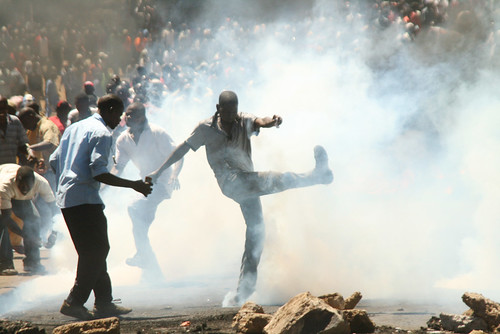
Before even talking about the current Constitutional battles, it's important to put the 2007 violence in context.
Kenyan politics are different from those in many countries. As one of my Kenyan colleagues pointed out, it's impossible to peg political leaders as left-wing or right-wing, progressive or conservative, traditional or modern. Although national politicians have views on particular issues -- education, trade, healthcare, housing, crime -- their positions don't really affect their voter base. Rather, political affiliations in Kenya are almost exclusively tribal. Kenyan politicians have an infamous and unfortunate track record of diverting public resources to their own -- or affiliated -- ethnic groups. Analysts have noted, for instance, that when control of the Presidency shifts from one group to another, funding to schools and hospitals in geographic areas populated by opponent ethnic groups tended to drop significantly. In light of such practices, it's easy to see how Kenyans could be very skeptical about politics and about the validity of their leaders' intentions. As a result of the patronage politics, elections (especially Presidential elections) are extremely high stakes. If your candidate wins, educated partisan cronies can expect plum jobs and the common follower can look forward to increased funding for public services. If he loses, however, they can predict that resources will be diverted to ethnic groups that backed the winner. A lot of this is described in Michaela Wrong's bestseller "It's Our Turn to Eat" -- http://www.amazon.co.uk/Its-Our-Turn-Michela-Wrong/dp/0007241968.
Combine high-stakes, patronage politics with endemic campaign corruption* and voter fraud and you can a lot of angry people at the polls.
It's an easy contrast with Tanzania, which has a drastically different political environment. Tanzania's post-independence leader, Julius Nyerere, had a very different vision for his country that his Kenyan contemporary Jomo Kenyatta. Nyerere had communistic ideals and believed that the natural mode of living for sub-Saharan Africans was a traditional, communal, family-centered village. He believed that the ideal economic mode of production was also the commune, a strategy which was not particularly effective for increasing agricultural output. Nyerere also stressed national unity - he oversaw the unification of Tanganyika and Zanzibar into modern-day Tanzania, promoted the use of Kiswahili as the official national language, and encouraged national Tanzanian identity over ethnic-tribal identities such as the Sukuma, Yao or Suba**.
If it's hard to say which approach is better, it seems obvious that the differences in vision between Jomo and Julius produced a real divergence between their countries. In Kenya, politics is contentious, tribal and high-stakes; in Tanzania, a single party - C.C.M. - has ruled the country since independence and political battles take place (when at all) around local parliamentary elections. In Kenya, people feel strong tribal identities and prefer to speak their native tongue or English (which they can do well); Tanzanians have embraced Swahili as a lingua franca but generally can't speak English well. Kenyans are (as a rule) entrepreneurial, competitive and trade-oriented; Tanzanians are more relaxed, more trapped by red tape and high tariffs, and less competitive within the region. Kenya performs significantly worse than Tanzania in terms of wealth and income inequality. (On land inequality: three families in Kenya each own 1 million acres of land. On income inequality: as measured by the UN's Gini coefficient index, a widely accepted indicator of income inequality, Tanzania has a 34.6 - in between France and Australia - while Kenya gets a 47.7, meaning that income distribution is more unequal than in the United States, and almost as unequal as Brazil).
Thanks to its more commercial orientation, Kenya seems to have come out ahead of Tanzania economically. In terms of politics, though, Kenya seems to have it bad: ethnic tension, tribal identities which override national unity and debate of issues, endemic corruption and substantial inequality in both land holding and income. As a function of these structural problems, political decisions (such as elections) can lead to violent results, often along ethnic lines.
Now that Kenya is moving full swing into the national referendum to approve the new Constitution, who knows how things will shake out? The Constitution contains the usual sorts of provisions found in constitutions drafted since World War II. There are the usual things related to the branches of government, stronger separation powers, the right to vote, to free speech, etc. These aren't controversial. Like many African constitutions, this one protects so-called "second generation" or "affirmative" rights: healthcare, education, housing, fair wages, culture, and family life, among others. Although it's unlikely that the Government of Kenya could actually provide all those rights, no one is going to object to that sort of language.
Three parts of the Constitution have been the source of debate:
- Abortion. Abortion is currently illegal in Kenya and you can go to jail to performing one or undertaking one. The Constitution officially outlaws abortion but provides for a number of open-ended exceptions that many conservatives (primarily Catholics) think will increase access to abortions in Kenya.
- Kadhi (Islamic) courts. The Constitution provides for the official establishment of Kadhi, or Islamic courts in Muslim areas. It also provides for exceptions to certain provisions of the Bill of Rights for professed Muslims. Although Kadhi courts currently exist (with statutory, rather than Constitutional backing), you can imagine that this has pissed off the Christian set.

- Land. It's a little unclear what Chapter Five actually means for land reform, but the section is widely understood to mean that the Constitution empowers government to ensure equitable distribution of land, including reversing some illegitimate purchases (land grabbing) that go back to the post-independence period. Because Kenya has such uneven land distribution, this is of major concern to landholders in the Rift Valley who stand to lose a lot if their sketchy land deals get investigated and possibly invalidated. As a result, Daniel arap Moi and his cronies have been telling Nairobians that if the Constitution passes, Maasai herders will come and seize all their land. Some people actually believe this.
But it's not just the major points of debate that pose problems. Getting a country of almost 40 million people, many of whom don't speak English and have limited schooling (let alone legal education), to understand a massive documents with hundreds of parts is an insurmountable task. As my driver yesterday, Peter, pointed out, he speaks English fluently but doesn't have the legal education to understand what the provisions really mean. ("If you have not been trained in the law, how can you know what this really means?"; "What does it mean if [the Constitution] says 'the government shall do something'? That's in the future."). Of course, there are people on both sides of the debate constantly telling him what it means, but he doesn't trust what they say. So even though he has read parts of the Constitution, he's not even sure he will vote in the end. Peter was most worried about his old grandmother in the village, who doesn't see well and can't speak English; he's concerned that if she tries to vote, the people at the polling station might trick her into picking something she doesn't want. Getting to the polling station is only half the battle.
All the issues inherent in the Constitutional referendum - the high-stakes outcomes, the propaganda, the lack of understanding of its contents, the underlying ethnic tensions - are going to make for an interesting vote next Wednesday. I just hope that no one gets hurt.
* Corruption is generally bad. Transparency International gave Kenya a corruption ranking of 146 out of 180 in 2009. This put it on par with Russia, Zimbabwe and Ecuador.
** There is one notable exception to the unity and uniformity of Tanzania - Zanzibar, which has courts with the jurisdiction to hear Islamic law claims and whose residents tend to vote for minority political parties such as the C.U.F. The Zanzibari exceptionalism enshrined in Tanzania's legal structure stems from the negotiations that took place at the time of union between Zanzibar and Tanganyika, theoretically a merger of two equal sovereign states. It's similar to special legal treatment for Texas or Quebec.
*** For a copy of the draft Constitution, click here: http://muigwithania.com/2010/05/05/kenyan-constitution-pdf/. Warning: it's long.
Thursday, 22 July 2010
Rebirth
Hey everybody. After a long wait, Tanzlines is back!
For those of you with whom I haven't been in touch recently, life has been busy since I last blogged. I've wrapped up my second year at Harvard Law, worked on some land-reform projects with the Millennium Challenge Corporation, taken a few personal vacations and spent two months as a deal-lawyer-in-training in Skadden Arps' Washington office.
As usual, though, I've found my way back to Africa. This time around, I'll be based in Nairobi until early September. I landed an exciting opportunity to work with the International Finance Corporation, a branch of the World Bank Group that helps countries grow through investment (rather than just aid). My project involves helping the governments of the Great Lakes countries (collectively known as the East African Community) reform their business laws in order to grow. But more on that later.
This season, you can expect the usual mix of Tanzlines posts: part travel tales; part thoughts on development, social enterprise and law reform; part musings on life in Africa.
Please follow me, share posts and write comments. More to come soon!
For those of you with whom I haven't been in touch recently, life has been busy since I last blogged. I've wrapped up my second year at Harvard Law, worked on some land-reform projects with the Millennium Challenge Corporation, taken a few personal vacations and spent two months as a deal-lawyer-in-training in Skadden Arps' Washington office.
As usual, though, I've found my way back to Africa. This time around, I'll be based in Nairobi until early September. I landed an exciting opportunity to work with the International Finance Corporation, a branch of the World Bank Group that helps countries grow through investment (rather than just aid). My project involves helping the governments of the Great Lakes countries (collectively known as the East African Community) reform their business laws in order to grow. But more on that later.
This season, you can expect the usual mix of Tanzlines posts: part travel tales; part thoughts on development, social enterprise and law reform; part musings on life in Africa.
Please follow me, share posts and write comments. More to come soon!
Subscribe to:
Posts (Atom)
