I'm leaving for the airport in a few hours, and I thought a last post was in order. I could wax lyrical about great the summer has been, but I feel like I've already made that clear in the last few posts.
Instead, let's do something different. Everyone likes top 10 lists, and I'm no exception. Here's one with my favorite parts of the summer:
10. Chillaxing @ Kipopeo Beach (free Kili with your entry ticket!)
9. Bongo Flava (not really part of the summer; more like the soundtrack to the summer)
8. Onion Rava Dosa from the Badminton Institute
7. Clubbing in Burundi with rappers
6. Cooking big dinners at the Annex while listening to 70s music
5. Stone Town on Zanzibar (esp. the food, the architecture, Jaws Corner)
4. White-water rafting the Source of the Nile (and getting tossed in)
3. Getting my Swahili good enough where I could use it for work
2. Seeing the wildebeest migration in Western Seregenti
1. Making some really great friends. I'll miss you guys.
Fortunately, I don't have a top 10 list of worst experiences. In fact, I can really only think of two things that were just plain bad:
-1. having my camera stolen and not being to get it back even though I knew who took it
-2. being robbed by a Ugandan midget
Apart from those two theft-related incidents, however, I had an absolute blast in Tanzania; definitely one of my favorite summers ever. But it's going to get even better in 24 hours -- I'm going to meet up in Bangkok with the gorgeous Stephanie. We're going to spend three weeks traveling around Thailand and Cambodia before heading back to Beantown. Temples, seedy Thai bars, cooking classes, elephant riding, SCUBA diving... it's gonna be good. Before you know it, I'll no longer be a mzungu... I'll be a farang.
I'm sure I'll be back on Tanzlines before too long, but until then, baadaye!
Friday, 31 July 2009

End of the Lion
[This will likely be my penultimate post from Tanzania. I get so few opportunities to use the word 'penultimate' that I felt compelled to do so here.]
Today is my last day at TechnoServe. It seems weird to write that (I feel like I just started), but this really is it. I've shied away from worky posts this summer, partly because it can be boring to read, partly because of that pesky Confidentiality Agreement. Now that I've started to say my goodbyes in the office, I figured one little work-related post couldn't hurt.
Today is my last day at TechnoServe. It seems weird to write that (I feel like I just started), but this really is it. I've shied away from worky posts this summer, partly because it can be boring to read, partly because of that pesky Confidentiality Agreement. Now that I've started to say my goodbyes in the office, I figured one little work-related post couldn't hurt.
Working at TechnoServe has been a good experience; some days, I felt that it was the ideal (unpaid) job I could have. I had a huge amount of flexibility to work on my own (which I love), free accommodation and drivers, a good blend of fieldwork, business thinking and legal work, plenty of interesting cultural experiences, and opportunities to use Swahili on the job. The hours were almost always 9-5, with a healthy hour-long lunch break in the middle. Most important for me, though: I really believed in the work I've been doing. I don't mind working hard if I know that the project has the chance to make a difference in people's lives, especially if those people are ekeing out a tough living as African farmers.
On many days when things seemed to be ticking along just too perfectly at work, however, I always ended up with a reminder that I really was in Africa after all: trips speeding through the dusk along bad roads in a car driven by a colleague who just learned to drive; over-juiced AC machines that could take you from sweating to freezing back to sweating in ten minutes; the day our receptionist was out sick with malaria and no one could make any calls for two days; that time in the city center trying to fix a punctured tire in time to get to a meeting. Plenty mishaps -- always annoying, to be sure, but in an endearing sort of way.
As I typed up my final reports this morning, I realized that I have gotten a lot done this summer in the end. The biggest piece of legal work I've done has been helping the government rewrite the regulations controlling the cotton industry here in Tanzania. In this country (as in most other cotton-growing nations), the cotton sector is overseen by a special regulatory agency -- here, it's the Tanzania Cotton Board. I've worked most of the summer with the more senior people there, and they're a good group, genuinely interested in improving the sector here. At the start of the summer they asked me to help them rewrite the Cotton Regulations. "We'll let the lawyer do his work," was what they said. Getting the chance to draft a decent chunk of the law largely by yourself is a very cool experience, especially as 1L summer jobs go. I met with the high-ups in government last week about the draft regulations and they're going to incorporate them into the law over the next few months -- exciting.
I'm also wrapping up some of the work I did with technology systems. A lot of development people these days are looking at ways to use information technology to help improve the lives of farmers. In East Africa, most of this stuff involves sending SMS messages to farmers, since the farmers don't have internet access or money to communicate other ways; the SMS messages can do anything from sending market-price information, to Q&A services, to information on the availability of goods, to mobile banking. I spent most of the summer designing a system that we could use to send both training and market-price information over the phone to cotton farmers; the training is to help them with agronomy questions and the local cotton-price reports help ensure that they don't get cheated by unscrupulous buying agents. I'm happy to say that we recently found a vendor who can build the system for a reasonable price, so the system will become a reality before too long.
No job is perfect, but working at TechnoServe certainly has been one of the best experiences I could have hoped for my 1L summer. But, now I'm done and it's time to start celebrating my last night in Dar. More to come soon.
No job is perfect, but working at TechnoServe certainly has been one of the best experiences I could have hoped for my 1L summer. But, now I'm done and it's time to start celebrating my last night in Dar. More to come soon.
Thursday, 30 July 2009
Anilelation
Things have gotten progressively busier this week and the old Tanzlines has slipped again into neglect. Sitting here immobilized after what is likely my last Indian meal in Tanzania, I thought I would write a teeny-little bit about the last step of last week's adventures: white-water rafting on the Nile. Uganda is known for many tourist activities, but the two big ones are gorilla trekking and rafting the Source of the Nile at Jinja. The rafting part always piqued my interest, partly because that part of the river has multiple Class 4 and 5 rapids (the largest that can be commerically rafted), and partly because of the mystique of the Nile.
It was a great ending to fun week of traveling -- I met up with Esther (the one based in Kampala), Kelly, Caris, and a group of Esther's friends, some of whom I had met before. All told there were two full rafts of our group tackling the great river. The Jinja rafting experience is pretty incredible: it's 7 full hours of rafting, including large stretches of peaceful paddling, easy Class 1, 2 and 3 rapids, and several massive sets of rapids that flip the boats. I was sitting at the front so I got the full thrill when we went over the rougher bits. One of the largest rapids was an 8-foot drop off of Silverback, which surprisingly didn't tip our raft. I was tossed out of the raft twice (the best part of the whole experience, and one I had been semi-secretly hoping would happen). The second time it happened, the entire raft flipped right on its head. Someone fell on top of me, which, combined with the surging water, is actually quite a suffocating experience even if it happens only for a short time. It was fine in the end, of course, and I managed to swim back to the raft easily. Altogether, one of the more fun travel experiences I've had this summer in Africa.
Unrelated to any of the above: I'm flying out from Dar this Saturday on Ethiopian Airlines. I was just trying to re-confirm my flight online and I came across this gem of a result on google: "Ethiopian Airlines (Amharic: የኢትዮጵያ አየር መንገድ; የኢትዮጵያ for short) is an airline based in Addis Ababa, Ethiopia." Sure, that makes sense -- "የኢትዮጵያ" for short... a lot easier to say when you cut out the whole "አየር መንገድ" thing.
Tuesday, 28 July 2009
Unphased
When I woke up today, I went down to take a shower. I turned on the taps and let the water reach full pressure. I got in after a few minutes and tried to adjust the temperature by turning the hot water tap... and I got shocked! I touched the tap again just to make sure I wasn't dreaming, and I got another jolt. Same thing happened when I touched the cold tap. Despite being in my just-woken groggy state, some part of my brain decided to get me out of the water flowing through the ungrounded pipes and onto the floor. I shut off the taps with a loofah and decided to skip the daily shower, you know, in favor of not dying. Then, I decided to shave over the sink and found that both of the taps there had live electricity flowing through them also. Even then the water flowing from the taps stung my hand when I touched it.
At this point, I had no intention of touching any metal or running water in the house. But I did have a scruffy travel beard to get rid of. I managed to shave without touching anything that could rapidly transfer electrons through my flesh, then I shut off the water using the old loofah method.
Now, I'm no union electrician, but this seems like a bit of a big deal. Electricity-charged showers are great for that guy from Crank who has to eat electricity to stay alive, but for the rest of us, it's definitely not fun. I'm going to call the fundi (random handyman) to fix the issue today. If I don't get the shower situation fixed soon, things are going to get unpleasant.
Monday, 27 July 2009
Burandomness
After a somewhat heavy day of genocide-related activities, I was ready for a little change. So we decided to get away and take an overnight trip to Burundi. At this point you are probably asking one of two questions:
Since you asked... Where: Burundi is a tiny, poor and relatively unknown country, wedged in between the Dem. Republic of Congo, Tanzania, Lake Tanganyika and Rwanda. Why: Bujumbura (the capital) is renowned as a good place to go out. And how often does the chance to go to Burundi come along?
I think there's a similar rivalry between the little guys in East Africa (e.g., Rwanda and Burundi). When we told Rwandans that we were going to Burundi for a day, they told us that we shouldn't go there -- "Burundians are lazy," "there's nothing to do in Buj," "it's dangerous," and the like. Surely Burundi deserves the chance to set the record straight.
The beach was filled with interesting comings and goings. A group of ballet dancers (think African, rather than European, moves) came to the beach to celebrate an alumni event with their troupe. They had a bunch of guitars, and danced and had fun on the beach. The other people were mostly locals having a good time and drinking Primus (during the workday, mind you). The only person who did not seem to be a having a great time was an old Belgian-looking guy -- perhaps a local UN dignitary -- who was being waited on by two local guys.
Overall, it was a great night. The seven-hour (bumpy) ride to Kigali the following morning, less great.
Thanks to Chrissy for managing to get pictures despite a nearly-dead battery!
- where is Burundi?
- why Burundi?
Since you asked... Where: Burundi is a tiny, poor and relatively unknown country, wedged in between the Dem. Republic of Congo, Tanzania, Lake Tanganyika and Rwanda. Why: Bujumbura (the capital) is renowned as a good place to go out. And how often does the chance to go to Burundi come along?
Natives of East African countries often emphasize perceived cultural differences with their neighbors. Tanzanians point out that Kenyans are pushy, cutthroat, loud, unable to speak proper Swahili, and prone to criminal behavior. Kenyans (at least those I've met) insist that Tanzanians are lazy, backwards, communistic, superstititous and slow-moving. Oh yeah, and they know about the Tanzanians eating albinos (fair point, Kenya).
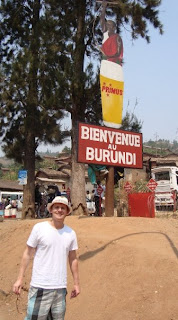
Getting to Burundi is actually a little bit painful. The Congolese and Tanzanian borders are very dangerous and often impassable for tourists. Even from Kigali, the trip involved getting up early indeed, speeding through the cold morning air on a moto-taxi, then taking a long minibus ride to the border in the mountains. The entry process at Kanyara-Haut seemed to confirm that the Rwandans might have been right about Burundian laziness; it took forever to get through the line. Eventually, the minibus driver had to intervene and took us around the back of the building to pay our visa fees to a comically surly official wearing a blue beret. Shortly thereafter, we were in. Bienvenu au Burundi!

The drive from the border to the capital was better -- lush, towering mountains for the eyes, African hip-hop favorites for the ears (for a sample, here's the Nigerian-based hit of the summer: http://www.youtube.com/watch?v=o771_Sc07uo). We got into Bujumbura mid-afternoon and decided to hit the town right away since we only had a single night there.
First stop was the famous Saga beach on Lake Tanganyika. Tanganyika is the second most famous of the African Great Lakes (after Victoria, of course), and it's a long, choppy lake -- a watery border between Tanzanian the DRC. The Burundian shore is regarded as a one of Africa's finest inland beaches and a great place to hang out for the day.
We parked ourselves at a little bar right on the sand, did some people watching and had a few beers. I tend to think that you can tell a lot about a country by its beers. Obviously the quality and range of options tells you a bit about the country's wealth levels. But the size of bottled beers even varies across countries. East African countries tend to favor 500 ml bottles (just under a pint), larger than the 330-ish ml bottles used in North America. Apart from cost considerations (large bottles are cheaper to distribute per unit of alcohol), I always assumed that the larger size reflected the fact that people like to enjoy themselves in this part of the world. If so, Burundian Primus bottles confirm that the people of that country really do like to party; Burundian Primuses weigh in at 720 ml per bottle -- roughly equivalent to a standard bottle of wine back home. Perhaps this is to one-up the Rwandans, whose Primus bottles only contain 500 ml, but it's still hilarious.

We parked ourselves at a little bar right on the sand, did some people watching and had a few beers. I tend to think that you can tell a lot about a country by its beers. Obviously the quality and range of options tells you a bit about the country's wealth levels. But the size of bottled beers even varies across countries. East African countries tend to favor 500 ml bottles (just under a pint), larger than the 330-ish ml bottles used in North America. Apart from cost considerations (large bottles are cheaper to distribute per unit of alcohol), I always assumed that the larger size reflected the fact that people like to enjoy themselves in this part of the world. If so, Burundian Primus bottles confirm that the people of that country really do like to party; Burundian Primuses weigh in at 720 ml per bottle -- roughly equivalent to a standard bottle of wine back home. Perhaps this is to one-up the Rwandans, whose Primus bottles only contain 500 ml, but it's still hilarious.

After dinner we met up with Amy, a friend of a friend from Dar. We joined up with three of Amy's local friends and headed to Toxic, one of Bujumbura's best nightclubs. Two of the guys -- Habib and Navio -- were members of five-man hip-hop group Klear Kut, one of East Africa's most prominent rap groups: http://www.busaramusic.org/database/artists.php?whereartistlike=Klear%20Kut. They've done a lot of interesting collaborations and worked with some big artists, particularly in West Africa. This is one of their biggest hits from a few years back: http://www.youtube.com/watch?v=7aLvyXd--2Q. Habib was also telling me that he's got the rights to Ismael Lo's song 'Africa,' in my opinion one of the best West African songs ever written -- should be exciting stuff when the sampled version comes out.
Amy and her friends were really welcoming and nice. They took us to their usual table in the VIP lounge at Toxic (they are rappers, after all) and we hung out there. Around midnight, the club was still practically empty since Burundians like to go out very late indeed. But people continued trickling in and the club was full before too long. We stayed out very late, switching it up between dancing to Congolese tunes, US hip hop and Bongo Flava, and hanging out in the VIP area, which was guarded by a ridiculously large dude who handled the mandatory red velvet rope.
Amy and her friends were really welcoming and nice. They took us to their usual table in the VIP lounge at Toxic (they are rappers, after all) and we hung out there. Around midnight, the club was still practically empty since Burundians like to go out very late indeed. But people continued trickling in and the club was full before too long. We stayed out very late, switching it up between dancing to Congolese tunes, US hip hop and Bongo Flava, and hanging out in the VIP area, which was guarded by a ridiculously large dude who handled the mandatory red velvet rope.
Thanks to Chrissy for managing to get pictures despite a nearly-dead battery!
Up next: rafting at the Source of the Nile.
Hotel Rwanda
[I'm back from my trip now, happy but exhausted. I'm going to cover the details over the next few posts.]
Day Two, Kigali.
In the morning, Chrissy and I went to the genocide memorial. It's a large, beautiful museum set on a hill in one of Kigali's suburbs. I wanted to see the place, not only because it's one of the few daytime activities in Kigali, but also because I'd read so much about the genocide during college.
The building itself is extremely tastefully done, no doubt generously funded by some Western country or another in a moment of intense, post-1994 guilt. The displays don't pull punches against any of the guilty parties; there's plenty of candid explanations about the Hutu architects of the killings, the role of the Belgians and French in supporting the genocide, and about the ordinary people who participated in the carnage.
On the way back to Chris' house, my moto-taxi stopped at a red light for a few minutes. In front of us was a pickup truck full of soldiers and prisoners in pink outfits. The pink suits are used to identify Rwandans who have been convicted of genocide crimes. Because the sheer number of people who committed crimes is so high and prison resources so strained, the government assigns them to public-works projects throughout the city. This group looked like they were going to do some digging or street cleaning.
Like many other East Africans who run into a mzungu on the street, the pink-shirted guys were motioning at me and trying to get me to strike up a conversation. But unlike most East Africans, these guys had almost certainly tried to kill innocent people in cold blood. I couldn't have smiled back at them even if I wanted to -- it just felt so unfair that the genocidaires were living out relatively painless punishments while the people they killed or maimed get nothing.
If running into genocidaires was tough for me, I can imagine how difficult that legacy is for Rwandans. Although there is a lot of discussion and controversy over both the reconciliation process and Rwanda's development path, the man at the heart of it all is certainly Paul Kagame. Kagame was originally the leader of the anti-genocidaire, Tutsi-dominated RPF rebels who restored peace to the country and ended the massacres in 1994. While there have been a few elections since that time, he's been in power for the past fifteen years.
Later in the day, I got to listen to the perspectives of two successful, pro-Kagame Rwandans who believe that the country is on the right track. The first was from Patrick, a friend of Chrissy's who has worked extensively in both military and civil roles in the Kagame regime, as well as in non-government position. Patrick acknowledged that the President had done a lot for the country in the economic sector, but he pointed out that Kagame had really secured national peace by offering a de facto olive branch to the country's Hutu majority. Even people who had participated on interahamwe killing squads before the RPF victory ended up supporting Kagame because, well, he didn't order them killed even though he could have. At Patrick's place, we watched a good (although not very hard-hitting) interview of Kagame by Fareed Zakaria:
www.youtube.com/watch?v=wc5a6P6VDGc
The second pro-regime view came from Jeff, one of my business partners and the CEO of a Kigali-based startup. He pointed out that lasting peace between the ethnic groups would only really be possible when the country was growing and prosperous enough to provide reasonable jobs to most of the young men. His idea is very plausible, and similar to the argument that widespread unemployment and hopelessness among youth in many Muslim countries leads to easy recruiting by al-Qaeda or other terrorist organizations. As a businessman, Jeff felt that the government's ability to attract foreign direct investment and promote economic growth was the greatest thing it could do for the country -- in Kigali at least.
Although the current regime remains overwhelmingly popular among Rwandans, it has come under attack from many groups abroad. Kagame and his former military allies have been accused of war crimes themselves, and have been indicted in Spanish and French courts, as well as criticized by certain members of the human-rights community: http://www.veritasrwandaforum.org/material/press_release_080208_eng.pdf
Even Kagame's supporters concede that the country is profoundly lacking in press freedoms and freedom of expression. As in many other countries, earlier jailings and harassment of anti-government press have led to widespread self-censorship by locally based media. Reporters Sans Frontieres, for instance, doesn't have great things to say about the matter: http://www.rsf.org/Rwanda,20737.html
Despite the obvious shortcomings of Rwanda's current path, I tend to think that the Kagame regime does more good than harm, at least in the short term. It has prevented further civilian killings, led a relatively successful reconciliation process that avoids further violence, and created a stable and growing economy with some foreign investment. All of these things are improvements -- surprising successes, even -- given the shattered state of Rwanda in 1994-5. The smoothly-running capital, the growing industrial base, and even the high prices suggest that things are on the right track, at least economically.
In the long run, however, I think that the lack of political freedoms and a viable opposition will become a major problem for the country, as they have for many other African countries. After all, when Mugabe first came to power in the Breadbasket of Africa, the world was thrilled to see substantial reform and growth; they simply turned a blind eye to the leader's lack of respect for civil liberties and his willingless to silence his opposition. You only need to look at Zimbabwe today -- hyperinflation, civilian killings, mass starvation -- to know how that one turned out. I hope that Kigali's upward trajectory will give its citizens the confidence to demand for political freedoms as well as increased prosperity.
That was Rwanda -- a little more than I planned to write. Next up, Burundi.
Day Two, Kigali.
In the morning, Chrissy and I went to the genocide memorial. It's a large, beautiful museum set on a hill in one of Kigali's suburbs. I wanted to see the place, not only because it's one of the few daytime activities in Kigali, but also because I'd read so much about the genocide during college.
The building itself is extremely tastefully done, no doubt generously funded by some Western country or another in a moment of intense, post-1994 guilt. The displays don't pull punches against any of the guilty parties; there's plenty of candid explanations about the Hutu architects of the killings, the role of the Belgians and French in supporting the genocide, and about the ordinary people who participated in the carnage.
The sheer scale of the killing is not what sets the Rwandan experience apart, although 10% of the national population died during that time. What I find craziest about it is the number of people who participated in the killing. Kigali in 1994 was not like the Armenian genocide or the Holocaust, with exterminations done by the military in remote places -- this was ordinary people killing their neighbors in all different parts of the city. Even today, many of the families of the victims have to live side by side with the people responsible for their deaths.
Although the musuem started out pretty factual, it built up emotionally towards the end. The last room was a display on ten-ish children who had been killed during the genocide, with pictures and descriptions about what they liked to do before they died. I kinda lost it there. I wasn't really expecting to cry, but the awfulness of the whole thing was just too much for me at that point.
At the end of the children exhibit, the museum opened up onto a garden terrace that overlooks the entire city of Kigali. I had a sense of relief when I walked out of the horrific displays and saw the new Kigali -- orderly, safe, clean -- ticking along just perfectly. But at the same time, it looked almost fake, like the past had just been brushed under the nice new Kigali. As we walked downhill from the memorial to the main road, I found it strange to see middle-aged people on the street going about their business. I just couldn't stop wondering how many of those people killed -- or helped to kill -- an innocent person during the genocide.On the way back to Chris' house, my moto-taxi stopped at a red light for a few minutes. In front of us was a pickup truck full of soldiers and prisoners in pink outfits. The pink suits are used to identify Rwandans who have been convicted of genocide crimes. Because the sheer number of people who committed crimes is so high and prison resources so strained, the government assigns them to public-works projects throughout the city. This group looked like they were going to do some digging or street cleaning.
Like many other East Africans who run into a mzungu on the street, the pink-shirted guys were motioning at me and trying to get me to strike up a conversation. But unlike most East Africans, these guys had almost certainly tried to kill innocent people in cold blood. I couldn't have smiled back at them even if I wanted to -- it just felt so unfair that the genocidaires were living out relatively painless punishments while the people they killed or maimed get nothing.
If running into genocidaires was tough for me, I can imagine how difficult that legacy is for Rwandans. Although there is a lot of discussion and controversy over both the reconciliation process and Rwanda's development path, the man at the heart of it all is certainly Paul Kagame. Kagame was originally the leader of the anti-genocidaire, Tutsi-dominated RPF rebels who restored peace to the country and ended the massacres in 1994. While there have been a few elections since that time, he's been in power for the past fifteen years.
Later in the day, I got to listen to the perspectives of two successful, pro-Kagame Rwandans who believe that the country is on the right track. The first was from Patrick, a friend of Chrissy's who has worked extensively in both military and civil roles in the Kagame regime, as well as in non-government position. Patrick acknowledged that the President had done a lot for the country in the economic sector, but he pointed out that Kagame had really secured national peace by offering a de facto olive branch to the country's Hutu majority. Even people who had participated on interahamwe killing squads before the RPF victory ended up supporting Kagame because, well, he didn't order them killed even though he could have. At Patrick's place, we watched a good (although not very hard-hitting) interview of Kagame by Fareed Zakaria:
www.youtube.com/watch?v=wc5a6P6VDGc
The second pro-regime view came from Jeff, one of my business partners and the CEO of a Kigali-based startup. He pointed out that lasting peace between the ethnic groups would only really be possible when the country was growing and prosperous enough to provide reasonable jobs to most of the young men. His idea is very plausible, and similar to the argument that widespread unemployment and hopelessness among youth in many Muslim countries leads to easy recruiting by al-Qaeda or other terrorist organizations. As a businessman, Jeff felt that the government's ability to attract foreign direct investment and promote economic growth was the greatest thing it could do for the country -- in Kigali at least.
Although the current regime remains overwhelmingly popular among Rwandans, it has come under attack from many groups abroad. Kagame and his former military allies have been accused of war crimes themselves, and have been indicted in Spanish and French courts, as well as criticized by certain members of the human-rights community: http://www.veritasrwandaforum.org/material/press_release_080208_eng.pdf
Even Kagame's supporters concede that the country is profoundly lacking in press freedoms and freedom of expression. As in many other countries, earlier jailings and harassment of anti-government press have led to widespread self-censorship by locally based media. Reporters Sans Frontieres, for instance, doesn't have great things to say about the matter: http://www.rsf.org/Rwanda,20737.html
Despite the obvious shortcomings of Rwanda's current path, I tend to think that the Kagame regime does more good than harm, at least in the short term. It has prevented further civilian killings, led a relatively successful reconciliation process that avoids further violence, and created a stable and growing economy with some foreign investment. All of these things are improvements -- surprising successes, even -- given the shattered state of Rwanda in 1994-5. The smoothly-running capital, the growing industrial base, and even the high prices suggest that things are on the right track, at least economically.
In the long run, however, I think that the lack of political freedoms and a viable opposition will become a major problem for the country, as they have for many other African countries. After all, when Mugabe first came to power in the Breadbasket of Africa, the world was thrilled to see substantial reform and growth; they simply turned a blind eye to the leader's lack of respect for civil liberties and his willingless to silence his opposition. You only need to look at Zimbabwe today -- hyperinflation, civilian killings, mass starvation -- to know how that one turned out. I hope that Kigali's upward trajectory will give its citizens the confidence to demand for political freedoms as well as increased prosperity.
That was Rwanda -- a little more than I planned to write. Next up, Burundi.
Wednesday, 22 July 2009
Motel Rwanda
[This post is a couple of days delayed. I'm writing from a hilltop in Kigali, the capital of Rwanda.]
Got to Kigali this morning. A few observations about Rwanda and about Kigali in particular.
1. Safety and Cleanliness
Kigali is a very well-ordered and clean city. This, apparently, is the work of Paul Kagame, Rwanda's President and a man who has worked very hard to keep the place very safe and nice to visit. There is very little garbage on the streets compared to other cities, and certainly compared to other African capitals. I saw a lady sweeping up fallen leaves just outside my guesthouse yesterday. That would be unthinkable elsewhere on the continent, where garbage is left to collect in open sewers or else burned at night (ahem, Dar).
My parents, if they read this, can take comfort in the fact that every single one of the city's moto-taxis carries a spare helmet for his passenger's use. The idea was comforting to me at first, until I noticed that the visor of the helmet I had been given looked like it had been shattered and re-fused two or three times -- not exactly a positive sign of the driver's safety record. Still, I've taken a few moto-taxis so far and they have been affordable, pleasant and safe journeys. Plus, wearing a visor makes me feel like I'm in an action movie, which has got to be worth something.
2. Unfrancophones
Rwanda is supposed to be a francophone country. When I arrived at the border town of Gatuna I was expecting some sort of language shift. Maybe I expected that the moment I stepped across the threshold into Rwanda, the touts and guards would suddenly start speaking in French. Not so.
In fact, I've been surprised to find that French has proven kinda useless, in Kigali at least. I had a long meeting yesterday with a potential business partner for TechnoServe -- that was all in French, simply because the other folks were educated Rwandans. But in the streets, almost no one seems inclined to speak French. Most of the young people speak English reasonably well (better than Tanzanians, but worse than Ugandans). And almost everyone speaks a pretty fair amount of Swahili, which is what I've been using to get around here. I've been impressed that people here speak two other languages well in addition to the national language (Kinyarwanda) and whatever other tongues they happen to know (often Lingala and Kirundi).
Kagame recently changed the official language of schooling in Rwanda from French to English. I wonder if the non-francophone thing is a reaction to the predominantly English-speaking aid community that has helped Rwanda in the post-genocide reconstruction period. Another factor is likely the fact that Rwanda and France severed political relations some time ago -- France assisted the genocidaires during the war and is currently trying to bring trumped-up criminal charges against Kagame for war crimes in French court.
3. Motel Rwanda
Perhaps it's the fact that my ethnic stock is 100% Scottish, but I have been known to cut corners (budgetarily, at least) when I'm traveling. Unfortunately, Kigali is not a cheap place by regional standards, mostly because the presence of the UN, World Bank and NGOs here has driven up prices drastically for any accommodation that might be remotely acceptable to foreigners. This leaves the Scottish-spirited corner-cutter with few options. I got to Kigali today and checked into a little motel called the 'New and Modern Guesthouse,' noted by my travel guide as one of the cheapest joints in the capital ($9 per night per room).
I can safely say that the New and Modern is probably the worst accommodation I've had in Africa. The room itself was OK, as far as unventilated cement rooms without mosquito nets go. The bathrooms, however, were something else -- to keep out non-paying people, the owner keeps the bathrooms locked at all times, so you have to track him down on the street outside if you want to use the facilities. And he waits outside the door until you're finished so he can lock up! I guess it gives a whole new meaning to 'bathroom attendant.'
But even once you get in to the old WC, it's not great -- very dirty squat toilets that made me feel like I was incarcerated in Gabon. Not that I've ever gone to Gabon (or jail, for that matter) but you get the point. They had (equally gross) shower stalls that were more cosmetic than functional, since there was never any water the whole time I stayed. I asked for water the day I was leaving and he owner pointed me to a bucket of soapy water that a boy was using to wash clothes; "this is your washing water," he said. When he saw I was unimpressed, he pointed out that the water was a plus because it already had detergent added so I would get clean more quickly. I was quite happy to check out the following morning.
Those were my initial thoughts on the city. Up next: a day spent exploring Kigali's dark past.
Subscribe to:
Posts (Atom)
